The First Reactions
The first volume of Caro's biography, THE YEARS OF LYNDON JOHNSON, is excerpted in "The Atlantic" -- and promptly attacked.

Thank you for checking out Big Reader Bad Grades! This is the third weekly installment in an ongoing series about Robert Caro’s five-decade opus, THE YEARS OF LYNDON JOHNSON. This week focuses on the first public preview of Volume One, THE PATH TO POWER, four parts of which were excerpted in The Atlantic Monthly just a few months prior to its November 1982 publication.
This post is partly paywalled, and I hope you’ll support the deep research going into this project by upgrading to a paid $5/month (or $50/year) subscription.
If you’re curious, here’s a link to PART ONE and PART TWO of the series.
Part Three
The First Reactions
In 1974, just before the release of his first book, Robert Caro saw the biggest payday of his career.
William Shawn, editor in chief of The New Yorker magazine, read an early copy of Caro’s forthcoming biography and decided to publish two lengthy excerpts, a total of 50,000 words, just a few months prior to the book’s September release; but then, as Newsday would report, “editors” kept reading and decided “they” wanted to double his original order: two excerpts became four, 50,000 words became 120,000.
The deal was “record breaking,” as several outlets reported, with William Shawn himself seeming to defend the pricey acquisition: “We thought it was irresistible.”
Shawn was only the second editor in the magazine’s history, five-foot-five (and a half), paleskinned; his presence is characterized as sort of a gliding slouch, hands in pockets, bald pate haloed with shine. Blue eyes. Soft handshake. Visitors to his office were not escorted inside, by a secretary, but greeted at the door, by its occupant. Before you get angry, running online searches for one of the few photos of this elvin recluse, finding, instead, unending photos of the popular actor Wallace Shawn—stills from Princess Bride and My Dinner with Andre and Manhattan—it’s worth noting that this actor is the editor’s heir and likeness.
Over daily breakfast at the Algonquin Hotel, across the street from his office, William Shawn would entertain a guest (often authors and editors) with small talk, as former-proofreader Charles McGrath recalls, about virtually any topic; he was, it seems, the sort of ideal, omni-conversant, eternally curious polymath built for helming a general-interest magazine. If you liked politics and dance, fine, he can talk about those. If it’s film and fiction, he can talk film and fiction. If you like late-night TV he can riff about that too because, contrary to the impression you might’ve gleaned from how much work he does, and the hours he keeps at the office, and his virtuosically gnomish ability to hang by the doorway at parties and then vanish before it’s gotten too late, Shawn wasn’t a big sleeper (much like his present-day successor, David Remnick, who terms the task of sleep—this 30% hemisphere of life, taxed each night to the sandman—“an insult”).
Yet neither did the once-young Charles McGrath (presumably over the course of many invites) ever see the great editor indulge a third cup of coffee at the hotel. Shawn was older by the time McGrath had come aboard. Probably quite conscious of the bowels. Though of course he’d never say that. Too crass. Shawn liked elegance. Clarity. He was, as William Maxwell called him, a “compulsive punctuator.”
[Shawn] believed all prose should be punctuated for clarity and logic according to rules that are set forth in Fowler’s Modern English Usage and are as applicable to one piece of writing as to another, this to prevent possible misreading.
Which isn’t to say that he was stodgy or dusty or difficult; “set in his ways” is how folks in his orbit might’ve put it. When the New York Times called him a “despot” in the headline of his obituary, they modified it, first, with, “gentle.” He was controlling, but also generous, as keen to give a fresh writer a shot as a foundering one a job; indeed there could be some ambiguity, in staffers’ accounts, about which of those things he’d given you.
Jacob Brackman, celebrating Shawn in a 1987 New Statesman obituary, remembers meeting a slightly older gentleman who “used to be on staff,” and who told him a little about the environment. A couple years later he runs into that “former” staffer again.
“I’m moving back to my old office.”
Apparently, years ago, this guy’d handed Shawn some exhaustively reported piece. When he ran into Shawn again, he doesn’t ask anything outright, lest the shy captain feel cornered, and so they spoke of other things and finally Shawn asked, “What do you plan on doing next?” The guy figured it was a gentle firing. Like a Hallmark card: Wishing You the Best. So he cleared out his office. Told the switchboard he was leaving and to do what they wanted with his phone number. Years later he runs into Shawn—who asks, again, “What do you plan on doing next? We’ve missed seeing anything from you for a while.” Then turned his palms up, don’t shoot, “not that I mean to put any pressure on you.”
As Shawn continued on down the corridor, the writer realized he’d been rehired or, rather, that he’d never been fired in the first place. Shawn had been evidently unaware of his absence as anything more than a normal delay in handing in a next article.
Stories abound of William Shawn’s 35-year reign at the New Yorker; but he was shy and private, his presence seemingly enjoyed on such a need-to-have basis that most of those stories are told in obituaries, or memoirs written well after his death, at which point the man himself is limned by the legend of his career-long dedication to a single purpose: reshaping the New Yorker from a popular humor magazine into one of the most influential publications in America; a “physically unimposing” man (The New York Times) who “did not change much over the years” (The Observer).
“He disliked crowds, fast driving, air conditioning and self-service elevators. (When the elevators at The New Yorker‘s offices…were automated, one was left in manual operation to accommodate him.)” His quiet glide from task to task, influencing the national discourse as he went, created a sense of disproportion, almost a credibility gap, between the man’s size and his influence.
That’s the gap where legends ferment.
To read about Robert Caro’s fifty-year project of writing his own Life of Johnson is to encounter an extremely focused, consistent, virtuosic writer of near-Pynchonian privacy, glimpsed like some solar event, once every decade, in a glut of publicity during which he tells the same stories, note-for-note, displays the same nervous tics, sits in the same office with the same suits and offers, to his interlocutor, the same humble New York-accented compliment. “Gee,” eyelids flitting, smile attesting the same rigorous dental hygeine, “y’ask cherrific queschins.”
A close examination of Robert Caro’s literary career—characterized by epic-length biographies that are, he says, studies in political power rather than political figures—manifests, itself, a study in power, as cultivated, challenged, and wielded in the world of publishing.
The four existing volumes of his Lyndon Johnson biography have taken, respectively, seven years to complete, eight years, a dozen, and then ten. Roughly a decade on average. (The fifth volume has taken fourteen years, and counting.) His original contract, according to a 1982 remark in Liz Smith’s gossip column and an early press release, was this: a trilogy, completed over the course of five years, for $1 million dollars. When the first volume took two years longer than the trilogy itself, the contract was renegotiated. When a single chapter of Volume Two exploded into a 100,000-word political thriller about Lyndon Johnson stealing an election, the contract was renegotiated again, turning his trilogy into a tetralogy.
And again, and again.
In the course of bringing this project to life he’s worked with the same agent, Lynn Nesbit, who over the course of these fifty years has become one of the most accomplished and famous in her profession.
He’s worked with some of the most venerated editors of his time: William Shawn (The New Yorker), William Whitworth (The Atlantic), Robert Gottlieb (in one capacity, as his book editor at Knopf, and yet another when Gottlieb, in 1987, took over Shawn’s post at the New Yorekr), and to—in a business capacity—with Gottlieb’s own successor as Knopf’s EIC, Sonny Mehta, whose eye for talent, even temper and knack for business, might have played a larger role than any other in shaping the contemporary American canon of the next three decades.
He’s been on seemingly every Sunday-morning news show and, back when they held more sway, evening talk show. He’s riffed with Dick Cavett and Studs Turkel and Fareed Zakaria and Terry Gross and Charlie Rose. In 2012 former President Bill Clinton reviewed Volume Four, The Passage of Power, for the New York Times (a rave).
When asked by Esquire, in 2012, if Robert Caro’s biography series (which had sold, by then, more than a million copies worldwide) was profitable, given how long they take and presumably how much money it costs to keep Caro in hornrims, Mehta answered, famously, with a pause. “They will be,” he said finally, “because there is nothing like them.”
These things aren’t profitable? Fifty years now this guy’s been skating past deadlines, expanding the scope of his project, saying things to reporters like, “I try to slow myself down,” and, “I don’t want to feel rushed,” while also insisting—sometimes with a gratitude that sounds choked-up—that his publisher has never once hassled him about deadlines, never once asked when he’d be finished with the next volume.
That’s power.
Meanwhile Caro seems to have discreetly rubbed shoulders with Hollywood. Another article from the 1990s claims he sold or optioned the film rights to Means of Ascent for $1 million. Famed director Rob Reiner said for years he was trying to adapt that book, but couldn’t, because HBO has full ownership of the series.
Is that true?
It’s not confirmed anywhere else.
One number I could find is that The Power Broker, now 50 years old, continues to sell roughly 40,000 copies a year.
To examine Robert Caro’s career-long exploration of political power, with portraits large and small of some of the 20th centuries greatest practitioners of that craft (the Kennedys, Al Smith, Coke Stevenson, Sam Rayburn), is to see how one of the era’s most powerful authors—commanding large advances, with unchecked freedom of time and scale and scope to tell his story, bowed under the weight of his laurels, securing an almost Pynchonian amount of privacy in all that time—has cultivated and wielded a remarkable amount of power in his own industry, and the luminaries with whom he’s done it.

Charles McGrath, remembering the episode in a 2012 profile of the biographer, describes the unsettling marvel of seeing Robert Caro, after the second of his four-part serial ran in The New Yorker, refuse to go on if the editor in chief was going to keep demanding such radical changes to the work. He was a
38-year-old unknown who hadn’t published a word except in newspapers[,] broke, hardly in a position to turn his back on the biggest payday of his life so far, [who] alone among New Yorker contributors at the time…dared to become a Bartleby and turn his powerlessness into a point of principle.
Bartleby isn’t the most obvious of Melville’s characters that draw closest comparison to Caro (number one is definitely Ahab; after that I guess it’s the whale), but the reference is apt: the young Caro was, at that point, bruised by a year-long editing process at the elbow of Robert Gottlieb, whose gently lacerating pencil had winnowed the book down by nearly half. And so he seems, in this encounter with William Shawn, less bothered by the task of editing than by…well, the thanklessness of the whole thing; and also by encountering, in Shawn, what Melville claims to’ve experienced when he first met Nathaniel Hawthorne, “the shock of recognition.”
Shawn, in spirit if not temperament, was so much like himself, but older; a venerated figure to whom he’d gained access by way of his own hard work and talent; someone who, having acquired Caro’s work and demonstrated its value by paying, most likely, a mid-five-figure sum for it, was refusing to say it was good enough, to let it stand.
It’s not unlike Caro’s relationship with Bob Gottlieb, at Knopf, so often characterized by this quote of elusive origin:
“In all the hours of working on The Power Broker, Bob [Gottlieb] never said one nice thing—never a single complimentary word, either about the book as a whole or about a single portion of the book…When we finished the last page of the last book we worked on, Means of Ascent, he held up the manuscript for a moment and said, slowly, as if he didn’t want to say it, Not bad. Those are the only two complimentary words he has ever said to me, to this day.”
Robert Caro braved unbending challenges to write the book, got it done, and seemed well-assured that he’d written something great. He was wary of how many copies it would sell, but the principle was the point: he’d seen through the veil, gotten his story, learned what needed learning.
What he seems to demand, more than anything, is that his work be taken seriously, accepted as is.
Forgive me as we do the Freud thing for a minute:
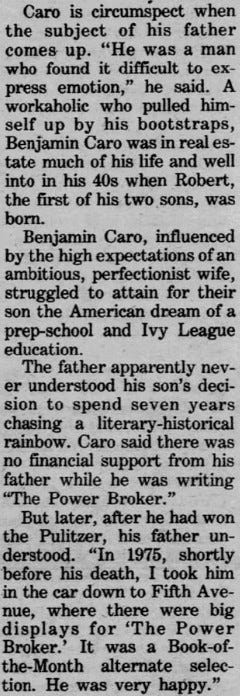
Caro has said little about his father, Benjamin Caro, beyond the fact that he was “very silent,” and “wasn’t really a reader.”
“It was an unusual household,” he told Charles McGrath in 2012, “in that I didn’t want to be there too much.”
If Caro’s descriptions of his father seem chilly, especially in old age, they’re more contextualized in his early publicity. He still portrayed his father as reticent but contextualized the man’s quiet with passing remarks about things he had done:
immigrated to the US from Poland,
taught himself to read English by copying out The New York Times in longhand,
honored his commitment to Caro’s mother, Celia, when she requested, on her deathbed, that Caro (eleven years old at the time) receive an education at Horace Mann, an expensive private school in Riverdale1.
While preoccupied, still, in articulating his father’s chilliness, it’s interesting that, when prompted to describe any of his father’s characteristics, the ones he emphasizes are those pertaining to work ethic.
A Newsday profile in 1982 said, of Benjamin Caro, that he
apparently never understood his son’s decision to spend seven years chasing a literary-historical rainbow. Caro said there was no financial support from his father while he was writing The Power Broker. But later, after [Caro] had won the Pulitzer, his father understood. “In 1975, shortly before his death, I took him in the car down to Fifth Avenue, where there were big displays for [the book]. It was a Book-of-the-Month alternative selection. He was very happy.
William Shawn, like Robert Caro, has swelled to the status of a literary monolith by merit of his dedication to a cause; the quiet, contained, forward-marching sense of purpose, of certainty, suggests the sort of faith in one’s cause (and self) encountered mostly in myth. They have each accrued to themselves, as a result of that discretion, a constellation of whispered anecdotes that, taken together, forge not a personality (complicated) but a persona (simple, sellable; the singularity of their purpose suggests a charmingly accessible and understandable self). With Shawn we hear about the shyness, the habits, the sincerity beneath his dark suits and his hats and his oval-shaped blackframe glasses; with Caro, in the same vein, we get his stories of how he stayed the course and earned the trust of reluctant or hostile sources and subjects, the sometimes-cartoonish depiction of a virile young man, ambitious, marching through the doors of a mythically overstuffed library in, of all places, Texas; there were thirty-odd million pages to review in the Lyndon Johnson Library when he started his project, in 1976, and today, after so many declassifications, there are several million more. The young man’s hair has gone grayer, thinner, and his posture has stooped somewhat. But there he is. Walking the same route. Taking the same seat. Performing the same task. Same red sweater. He took his typewriter into the Library a couple times but they asked him to stop because of the noise.
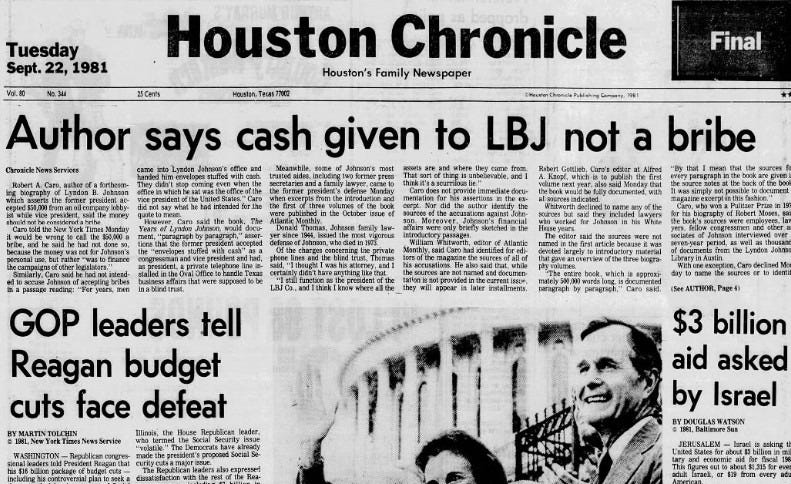
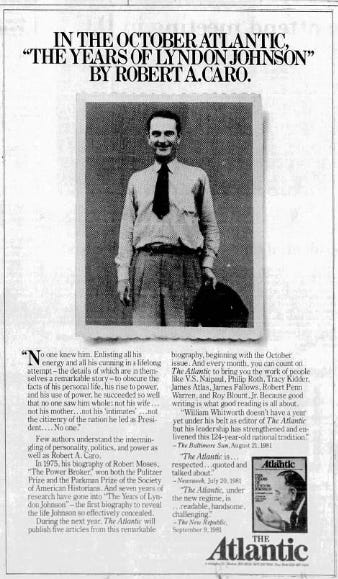
This third installment in the series shows Robert Caro embarking on The Years of Lyndon Johnson, and then stepping away from the scene for a while, working on the book in Texas for four years, then writing it in New York, and finally returning—with excerpts of the completed tome—to the magazine ecosystem with which he’d only had one prior experience, a very fraught and unpromising one; however, as with all of Caro’s books, he returns to his audience in a different decade, presenting his unchanging brand of ambitious storytelling to a readership that keeps evolving.
This week we see the world’s first reaction to The Years of Lyndon Johnson.
