The Fifth of Three
Part One of a series on Robert Caro, who at 90 is still writing the final volume of a trilogy.

This is the first in a series of posts about Robert A. Caro’s fifty-year biography of Lyndon Johnson: how it started, how it endured, and the changing literary ecosystem in which, once ever decade, a new volume landed.
The second half of this post is for paid subscribers only. Please help support this project with an upgrade.
We begin in 1974, with a five-pound book nobody expected to sell.
Part One
The Idealist
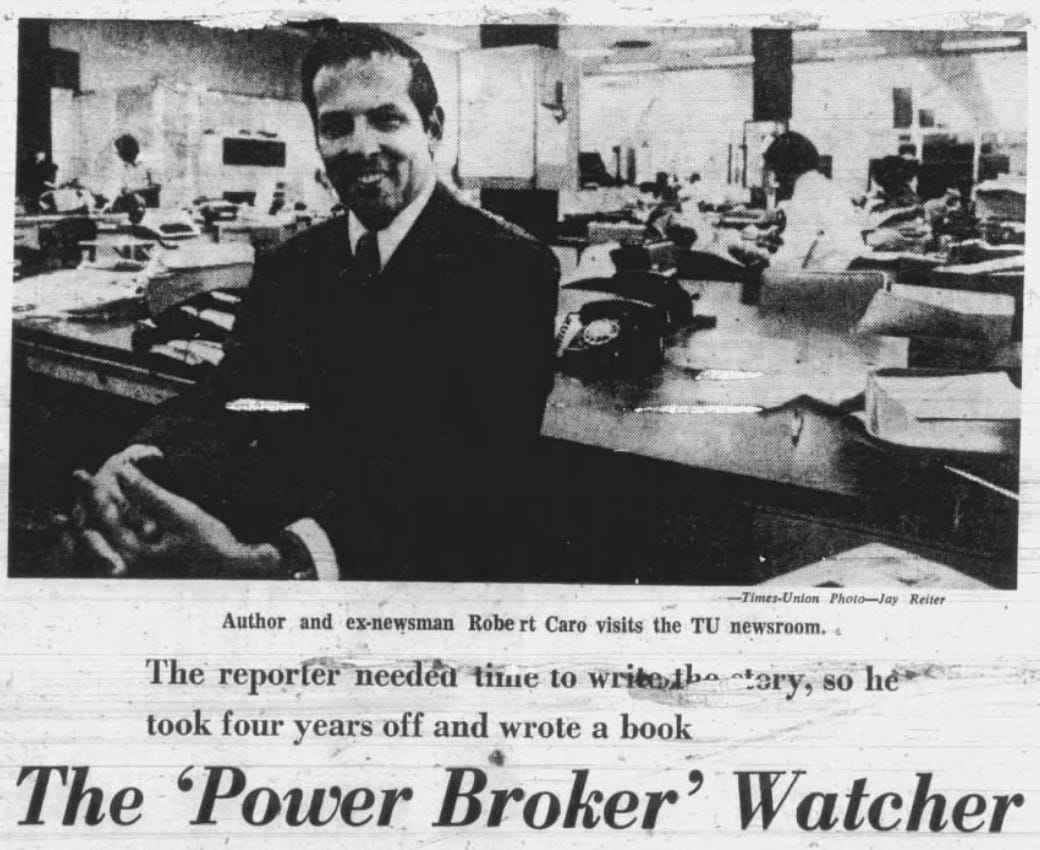
Robert Caro’s first book, The Power Broker, is a 1,336-page biography of New York City urban planner Robert Moses, most famous for overseeing the construction of more than 600 miles of highway, and who incidentally was still alive when the book came out, and pissed about it, putting out a 25-page letter to the press in which he accuses Mr. Caro of “mistakes,” “unsupported charges,” “vicious canards” — all in hopes, presumably, of slowing sales, worrying the publisher, scandalizing the author. But reviews were already getting filed, well in advance of publication, and they were glowing. Called the book a “monument.” Gore Vidal in the New York Review of Books would say that The Power Broker “has not only taken me a month to read (there are 1,246 pages) but not once—uniquely—did I find myself glumly riffling the pages still to be read at the back.” If Moses had any influence on the published book, which took seven years to write, it was to release a cry so shrill, snobby, smoky, it could only help sell more copies.
And Power Broker needed the help.
Weighing five pounds, and containing as many pages as bookbinding technology could then accommodate, The Power Broker isn’t just the biography of an obscure city official in the early twentieth century, which would be daunting enough for most readers, but a work of urban history, too, and a study of political power—plus Caro spent a painstaking year, shoulder to shoulder with his editor, whittling it down from roughly one million words to roughly 650,000, meaning it isn’t just lengthy but dense; still more daunting, it came dressed in a fancy white hardcover with a sticker price of $17.95 (roughly $130, in 2026), and it was published under Random House’s most prestigious imprint, Knopf, which for all of its literary cachet and clout could also, for the average reader, carry an eat-your-veggies kind of aura; plus, if you were savvy enough to know who Robert Moses even was, you probably also knew about Robert Gottlieb, Knopf’s bigshot editor in chief, who not too long ago, at Simon & Schuster, had handled Joseph Heller’s blockbuster first novel Catch-22, then a couple years later, at Putnam, Mario Puzo’s The Godfather; plus he was known for what Tina Brown would later describe, in her diary, as “self-consciously idiosyncratic…as if he is working overtime on being famously eccentric,” meaning he knew he had this reputation for reading a book in a night, for never having lunch outside his office, for being disheveled, erratic, working really hard, sitting on floors instead of chairs—and he leaned into it. Michael Korda, fellow editor at Simon & Schuster in the ‘60s, writes of how Gottlieb was constantly folding back the lock of hair that fell across his face, after which it immediately fell back the same way. “His glasses, I noticed, were so smeared with fingerprints that it was a wonder he could see through them.” Colleagues and authors and friends called him a genius (though Tina Brown, in her Vanity Fair Diaries, says the label was forged of “manufactured eccentricity and unassailable self-confidence”), and by the mid-1970s, whatever the label’s legitimacy, Gottlieb had cultivated an author list, across three publishing houses, to back it up; he’d even survived a scandal, a villain label that endured for quite a while in the mid-’60s, after he’d received, at S&S, a manuscript from a young writer out of New Orleans named John Kennedy Toole, a situation that culminated—as Gottlieb says in his memoir Avid Reader—with “the most conspicuous failure” of his career.
Toole’s novel, A Confederacy of Dunces, showed talent, but had a “sophomoric” view of the world, so Gottlieb sent it back with some editorial pointers that Toole accommodated, and returned. Gottlieb saw the changes, suggested more, and sent it back. This went on for two years. Gottlieb invited Toole to visit him at S&S but, on both occasions that Toole showed up, Gottlieb was out, and according to a 40th anniversary retrospective on Toole’s posthumously published novel, the second of those visits prompted a nervous breakdown right there at S&S.
Eventually Gottlieb passed on the book. Toole, back home, connected a garden hose to his car’s exhaust and took the other end inside with him. Afterward his mother, Thelma Tool, pitched the book to a few other imprints. It got published, sold thousands of copies, and won a Pulitzer. Thelma Toole would later describe Gottlieb, in an interview with Horizon, as “a creature…a Jewish creature…Not a man…Not a human being.” Gottlieb considered a lawsuit at the suggestion that he, “as an East Coast Jewish elite…had deliberately destroyed” Toole, “but came to feel that if such inflamed delusions were helping to assuage the grief of an unhinged mother whose son had killed himself, I could afford to swallow my outrage.”
Toole became a kind of martyr figure for undiscovered geniuses who felt chewed up and spat-out by publishing elites, and Gottlieb—for those interested enough to parse details of the story—an image (barring Ms. Toole’s anti-semitic slant) of publishing’s elitism; it was easy to characterize Gottlieb’s two-year correspondence not as a gesture of kindness, of genuine interest, but malice, some extremely elaborate and time-consuming joke.
The Power Broker wasn’t just a ballsy and expensive debut from a nobody reporter at Newsday, it was the closely-tended passion project for one of publishing’s own power brokers.
All to say that, by the time it went on sale in September of 1974, The Power Broker—baubled, on release day, in myriad signifiers of in-house faith and literary prestige—had eaten lots of time, money, and attention from several people whose time, money, and attention were in high demand; none of them, it seemed, having very much reason to think it would actually perform all that well in the market.
Least of all its author, who told Newsday columnist Stan Isaacs that he didn’t expect to sell many copies (the price alone was mentioned, mocked, lamented by a number of critics, almost always in the context of how dramatically it would limit the readership) but that his hope, should the book have “any effect” on the market, it’ll be to “make people stop thinking of public authorities as non-political. We have created a fourth arm of government with public authorities, and people don’t know it.”
How noble. The book’s opening section is called “The Idealist,” in reference to the young Robert Moses as an angry crusader for good government, and it’s not the first note of resemblance between author and subject. If indeed his hopes were so humble then it seemed, from that first tide of critical reception (and the book’s hasty appearance on college curricula), that he’d achieved what he set out to accomplish, even if he was lastingly upset about the 300,000 words Gottlieb had carved from his flank (the length, as Gottlieb would say, of three normal-length books); plus, if you’ve been mired for seven years in tracking down the horror stories about Robert Moses, it was probably gratifying to’ve gotten a rise out of him, to know that this elderly racist, tormented by a sense of public erasure and dwindling power, had devoted several hours to a furious 3,500-word rebuttal that probably nobody read in its entirety; Moses, for whose “genius” Caro had cultivated certain amount of respect (maybe “fascination” is the better word, cuz his conversational treatment is teeming with contempt), had overseen the construction of highways, expressways, parkways that’d displaced hundreds of people, destroyed lives, treated the city of New York as a theater for political gamesmanship.
“It is slightly absurd,” quipped Caro, “but typical of Robert Moses,” rebutting the -buttal, “to label as without documentation a book that has 83 solid pages of single space small type notes and that is based on seven years of research, including 522 separate interviews.” (“I know the number,” he’ll grumble to C-SPAN 52 years later, “because they made me count.”)
Reviewer Justin Kaplan would cite those same metrics (interviews, pagecount, citations) in the Detroit Free Press: “This is the kind of quantification Moses would use to celebrate the completion of one of his highways or bridges. This monument of Caro’s was very much worth building.”
The Power Broker didn’t hit the New York Times bestseller list in the season of its release, where it might’ve made for poetic company alongside Aleksandr Solzhenitsyn (The Gulag Archipelago), Peter Benchley (Jaws), plus fellow investigative reporters Carl Bernstein and Bob Woodward (All the President’s Men), but was “selling well,” as one paper seemed impressed to report, despite the cost; Buffalo News reporting, just one week after its release in September, that Knopf’s first printing, of 35,000 copies was being followed with a second printing of 40,000 more. The Book of the Month Club paid an undisclosed amount in picking The Power Broker for their alternate selection, printing another 10,000 copies for January 1975—the same year it would win a Pulitzer Prize, a Francis Parkman Prize (awarded for works of history), and became a finalist for the National Book Award.
The Pulitzer Prize came with a $1,000 cash component, which probably still meant something for young Caro and his wife Ina (also his sole and full-time researcher), who together had been scuttling around the city on the brink of poverty for seven years, raising their young son Chase, scraping by on virtually no income at all, defaulting on tabs at the butcher shop and dry cleaner, selling their Long Island house at one point, for $25,000 in-hand, to stay afloat another year; but the Caros were also just getting a taste of the lifestyle they’d enjoy the rest of their lives. Not always lavish, but comfortable. In early 1974, prior to the book’s release, they enjoyed a windfall, of sorts, when Lynn Nesbit, Caro’s new agent, sent reams of the book to William Shawn, the New Yorker’s editor in chief. Shawn called the book “irresistible” and decided, quickly, that he wanted to run two excerpts in the magazine, a total of 50,000 words (huge, even at the time); but then, as Newsday would report, “the more the magazine editors read, the more they liked it, and the magazine finally ended up with 120,000 [words].”
Raleigh’s News and Observer lamented, in yet another rave, that The Power Broker’s “unusually high price tag probably will keep it out of the hands of many readers,” but reminds us that “nearly a quarter of the book was excerpted in four consecutive issues of The New Yorker” that summer.
Which is mostly true.
The excerpt was alleged to’ve been acquired for more money than the magazine had ever spent on a piece of reporting, and Caro, years later, would confirm that, at the time, it was the single largest sum of money he’d ever received.
All of which would seem to portend a harmonious relationship, both parties feeling they’d landed on something special; but the whole thing got contentious to a point that—as Charles McGrath, then a proofreader at the magazine, would report in 2012—there came a one-week gap, between the second and third excerpt, where the series was held in suspension, and it seemed the deal might fall apart, that the author would walk.
Caro, it turns out, was pissed about the extent to which Shawn was demanding that his excerpt’s prose conform to the house style; the book’s long multi-clausal sentences, which sometimes ran the length of a paragraph if not half a page, were, in McGrath’s words, “too leggy and indirect” for William Shawn’s taste, for New Yorker standards. It became the burden of a younger editor, William Whitworth, to negotiate the differences with Caro personally. McGrath remembers Whitworth “wearily shuttling back and forth, like some Balkan diplomat,” between Shawn’s office and the office of a vacationing staffer in which Caro’d set himself up, gotten to work at truncating his own prose, and then snapped.
“Here was a 38-year-old unknown who hadn’t published a word except in newspapers,” says McGrath, but he stood up to William Shawn, the most prestigious figure in the most prestigious magazine, until the old man caved, and “agreed to restore all the changes [Caro] cared most deeply about.”
He had worked hard, had employed such time, tenacity, and rigor as to become a source of envy and inspiration to his colleagues; and in the end, when an institution had been too rigid to accommodate him, Caro stood pat, and bent them to his shape.
It would not be the last note of resemblance between the author and his subjects.
