"We Always Leave Things Unfinished"
William T. Vollmann is dying. In his Sacramento studio, he talks America, unfinished work, and the 3,096-page opus he finished just in time.

This piece was independently reported and self-financed. If you value work like this please consider becoming a paid subscriber. It helps make future pieces like this possible.
William T. Vollmann’s new novel is called A Table for Fortune.
It’s 3,096 pages.
It’s probably his last.
He doesn’t have a cell phone or use the internet so it takes a week to get the answer but finally his publicist comes back with a politely breathless email confirming that, yes, if I can make it out to Sacramento next week William T. Vollmann will meet me at 9 a.m., June 23, at a small coffee shop that’s been built into an unsuspecting structure and then from there we can walk to his studio, hang out til around noonish.
It’s June 15th.
I start reading his new novel, A Table for Fortune. It comes out in August. It’s 3,096 pages. Calling around, preparing the article, I mention to sources that I’ll be flying out and interviewing Vollmann. A source implores me to read as much as I can. Says they saw someone talking with Vollmann, pretending to’ve read the whole book, but then got outed. I ask if Vollmann was angry. They wouldn’t say angry, no…more like “visibly upset.”
I read faster.
It’s about a CIA intelligence analyst. His name when he’s home is Elliott Stevens but at Agency HQ his name is DAVE (all caps). He was a helicopter pilot in Vietnam. He has a genius IQ and photographic memory. He comes home and settles down with his all-American girlfriend Sally. He lusts after his sister-in-law. He reads reports. He promises things to his wife without much intention of honoring them: a vacation, a new house, a child. She bores him. He loves her.
It’s about the world slowly changing as you go about your job.
It’s gripping, complicated, entangling.
There’s no chance I will finish in time.
The book’s editor, Isaac Morris, explains over the phone how A Table for Fortune is divided into basically two hemispheres: DAVE’s, at the CIA, and later on the life of his less-intelligent but more empathic son Matthew.
It’s the latter part where he feels the most moving material, the heart of the book.
I tell him I can only read so much before the interview. Should I skip Volume Two and read some of Matthew?
He says if I’m really short for time, and want a thorough sense of how the book works, then yeah, I might want to jump ahead.
I cross the country and get to the coffee shop at 8:45 and he’s there already, dark jeans with a black windbreaker, typing in an armchair. He studies me from a few paces as I go toward him. Hackles up. Thirty years ago while researching a novel in the arctic his sleeping bag caught fire and his eyebrows have never grown back but I can see a slight pale ridge lifting with welcome once my hand is out.
Vollmann shuts his laptop. Goes quickly to his feet with an “oh hi” and other niceties, knees bent and arms kinda wide like a gunslinger.
There’s an empty mug beside his chair. He’s been here a while.
I’ve only read 700 pages.
Vollmann bags his things while I buy a Pellegrino and then join him in the dining room. Awkward in our backpacks til he leads us out to the sidewalk and I ask what he was working on.
“I’m doing this piece about Cuba for Harper’s.”
It’s a shady suburban-ish street full of walk-ups. He tells me about interviewing people around Havana and how they’d hide their faces or ask to stay off-camera while telling him how bad the fuel crisis has gotten. The average bus is three hours behind schedule, so they’ve got these special white buses so that “at least the doctors and nurses can get to the rat-infested hospitals on time.” At one point he felt guilty at being driven around so he could conduct his reporting but then a taxi driver told him, in confidence, that for him, personally, it makes more sense to sell his monthly fuel allotment, on the black market, than to fill up his car and try to shuttle a living.
Vollmann moves quick and tilty up the sidewalk. Our elbows graze and his windbreaker says “vwip,” “vwop,” the walk feeling almost like a jog until finally he slows, we’re getting ready to jaywalk, and as he leans out, checking both ways, he apologizes about moving so slowly.
“I have cancer.”
What makes the Cuba situation so “sad” (and he does keep calling it sad despite the swell of what looks like anger) is that it doesn’t have to be this way. Mexico wants to give them oil. The island could bounce back in a few weeks. But Donald Trump signed an executive order imposing tariffs on any country that sends oil to Cuba.
“I was just so disgusted and ashamed of our country to see all these heaps of garbage that can’t be picked up, cuz there’s no fuel,” and so residents are dragging their trash outside to the street and burning it in piles. “You’re breathing the smoke of garbage. And there are these people bending over through the smoking garbage trying to find food. So we’re uh,” blinking like to ground himself, facing forward and switching to his prose voice, that monotone, “we’re really making Cuba great again,” irreverent.
No sense getting worked-up about these things.
“I’ll be dead very soon.”
“Chemo mind” keeps him in a fog. The cancer causes pain such that he can hardly sleep. “Last night I got about an hour.” When he finally got up he had to take an opioid, which makes him “fuzzy.” All of this is compounded by the medical marijuana that’s proven a great help but leaves him kinda fried. “I couldn’t believe, after a couple weeks in Cuba, how much sharper I was, mentally, because all I had was my opioids.”
Hence he’s not tangled in any big fiction project right now. For nearly 40 years he’s been working simultaneously on each volume of a sprawling septology, Seven Dreams. It tells the history of the North American continent. Volume Five, The Dying Grass, came out in 2015. Reviews were glowing. The Washington Post called it “the reading experience of a lifetime.”
But every book since then has been a problem: too many pages, too many fonts, the title’s controversial, there’s too much math; releasing a two-volume art book in 2022, with a pair of understaffed indie publishers, Vollmann kept getting galleys sent back with typos throughout, shoddy production quality on the photos, publication running a year behind schedule. He doesn’t have the time for it anymore. He’s working on two short books right now: one’s a long personal essay, the other one’s literary criticism. Straightforward stuff. There’s no mention of fiction.
“Do you feel any pressure to finish Seven Dreams?”
“I’m not gonna touch it.” Resigned and certain. He says finishing even one of the two remaining volumes would likely take “more time than I have left.” Plus the fights it’ll prompt with his publishers. “About a quarter of the last one is completed, and then much less of the other one.”
“I don’t want it to come out looking like a piece of crap so,” he flaps a hand, hits a thigh, “just forget it.”
He shows me a wall with a long art sequence called “CUNT,” with a collection of other paintings beside it: nudes and studies, bodies warped and accurate, writhing or posing. The display is a proud one. He seems happy to show me.
Above the paintings there’s a shelf with a row of framed photos. Artful black and white from reporting trips around the world. Vollmann himself in drag as “Dolores.” A Black soldier. A woman cradling one child on her hip while holding the hand of another. His daughter Lisa in a school photo, smiling.
The illness didn’t feel like much of an obstacle in his Cuba trip, though he did worry about getting detained someplace, his opioids stolen.
In 2024 Harper’s was planning to send Vollmann to Tajikistan.
“That’s when my cancer came back.”
So they waited a year. When he was clear to travel, they proposed sending him to Iran. He was interested in seeing the Strait of Hormuz.
But unlike his earlier war reporting—in Bosnia, Iraq, Somalia, Ukraine, the DMZ, to name a few—he’s budgeting his energy. Assessing his comfort. “I looked at [the Iran trip] and thought, ‘No. I don’t want to fly into Tehran and then go all the way across the country, to the Strait of Hormuz, getting insulted and detained and threatened, [and] maybe never even get[ting] there.” Hence: Kuwait. It’s nearly a thousand miles from Hormuz, but it made more sense. “I’m getting sickerrr, I tire more easilyyy, I can’t run as faaast…”
We pass a youngish couple walking their dog and Vollmann jolts his voice for a cheery good morning, which they return, and we keep on walking.
“It may be the last of these war things I can do.”
Harper’s offered him some easier topics. Cryogenic immortality was one. He mulled it over and told them, “Y’know, I just don’t care about those rich people, and I probably wouldn’t have a nice enough necktie to talk to them.”
Passing a homeless guy with a hoodie and aimless red-eyed shuffle Vollmann jolts his voice for a cheery good morning. The man blinks. Pauses. Watches us pass. “Mornin.”
He’s writing the Cuba piece across three documents. He opens his laptop and checks the wordcount for me: 32,000.
Ambivalent frown as he shuts it: “So that’s not such a long article.”
He knows they’ll cut it down but, contrary to a reputation for being difficult with publishers (“that craphead Vollmann,” he calls himself), he’s not bothered. “Why not be a compliant prostitute?” A magazine isn’t presenting itself the way a publisher does. “They don’t pretend [this article will be] the ideal length that’s gonna make this piece shine. It’s the length that works for them, based on the number of ads they have.” Plus he can always take the whole unexpurgated draft and use it in a book.
He’s working on two nonfiction books that’re nearly complete but otherwise feels no stress about what’s left behind. His voice gets tighter as he talks about things he’s leaving in the drawer. “They’ll either come out or they won’t, and,” pausing, his voice breaking, “I’ve done a lot of what I set out to do in my life.”
Does this feel like a crowning achievement?
“Yeah. It does.”
He asks me, “How do you like Sacramento?”
“I’ve never traveled this far.”
“Oh!” Pale ridge raised.
I tell him it’s a nice quiet place but really it just seems quiet. Lettered cards in a second-floor window spell F U C K and then I C E underneath it. Intricate murals on the sides of squarishly huge buildings preside over streets with no traffic or pedestrians. The two-car light rail skakunking and chiming throughout the day, more heard than seen; when it finally comes gliding around a corner its windows are so tinted I can’t tell if anyone’s inside.
Vollmann leads us into an alleyway and it seems like a shortcut but no he stops at a gate and I realize this is the former Mexican restaurant Ortega’s that he bought in 2000 and converted into a studio. The building is closed-in with a tight perimeter of chainlink fence.
Someone down the alleyway sees us and steps behind the building.
Keys jangle and scrape and a latch snaps and Vollmann holds the gate open so I can step through and then he follows, turning in the process, clacking it shut right behind him and locking it. When he moves toward the studio’s door I step aside too eagerly and find my face real close to the spirals of razor wire bundled frothy and low along the fence. From six inches I’m surprised to see that the razors resemble the ones they put in my box cutter at work.
The studio is dark like a tunnel. It smells like tools and carpet. Then he hits the lights and every inch seems bright. The windows are boarded and covered with bookcases. He goes to straighten something behind what used to be a bar and I start taking out my equipment. When we’re not talking we can hear people through the back wall. There’s an argument. They’re dragging something heavy over pavement.
After a chat he gives me a tour through every room and highlights some of the images that cover each wall. Photo portraits of women posing shoulders-back and serious. Two guys conversing, shot from below, some sort of power dynamic implied. There might be more breasts than faces.
In the dark room I’m looking around at his equipment and it seems untouched. He says the chemicals make him sick lately. Taped to a wall above the countertop is an advertisement for wigs. It shows a Black woman, smiling, staring at something 45 degrees off-camera; her image is recreated, eight or ten times, with a different wig in each one. I point to the advertisement and ask if it has anything to do with his cross-dressing alter ego Dolores. He says no. I ask if it’s a reference sheet for something he’s working on and he says no. I ask if he just likes this advertisement showing a woman wearing ten different wigs and he says basically yes.
As we’re setting up for the interview I hold up the Pellegrino can and ask where to throw it away.
“Um,” he takes the can, gentle and friendly, “let’s just put it someplace that we’ll remember to grab it on our way out.” The next day at the airport I’ll remember that he spent a dozen years working on a two-volume opus about climate change, called Carbon Ideologies, in which he flashes contempt for the phrase “throw it away,” and how we all indulge this cozy abstract location—“Away”—which almost certainly, in the speaker’s mind, does not suggest a mile-wide landfill, swarming with pollutants and illness, crowned in the sun with a winking Pellegrino.
Earlier, while walking, I asked about the extent to which he still lives with a subject after writing a book about it; roughly a dozen years of travel and research and reporting, for instance, went into Carbon Ideologies, for which he traveled out to Fukushima’s radioactive “red zone,” dressed in plastic gloves and a face mask, where he saw weeds uprooting the sidewalks and wild boar clicking along unhurried through desolate city streets. He learned that “one of the crazy things about being a nuclear refugee is that you are still on the hook for the mortgage of your radioactive house.” That book is almost ten years behind him. Are the facts he learned still part of his daily thinking?
He tells me yes and no. That he’s loosened up a bit.
“There’s no rush for a solution,” he says of the climate apocalypse, “because it’s too late.”
DAVID GREENE: William Vollmann, I’m just curious. I mean, last time we spoke, we talked about how the FBI thought you might be the Unabomber. You’ve traveled with the Mujahideen. You’ve smoked crack with prostitutes in California. I mean, you have a certain style of sort of your reporting where you want to be in the middle of something, so to speak. And here, you’re exposing yourself to radiation. I mean, what drives you?
VOLLMANN: Well, one time I read an E.O. Wilson book about the ants….He says that it’s common in ant colonies for the older female ants to take more and more risks. They’ve already reproduced, and if they don’t come back, it’s no real loss to the ant colony. And I’m an older person. I’m 55. I’ve reproduced. I’m going to die in any event, so I have less to fear. And I would really like to try to do some good in the world before I die and, you know, if I get cancer as a result, it’s no real loss.
—NPR Morning Edition, 2014
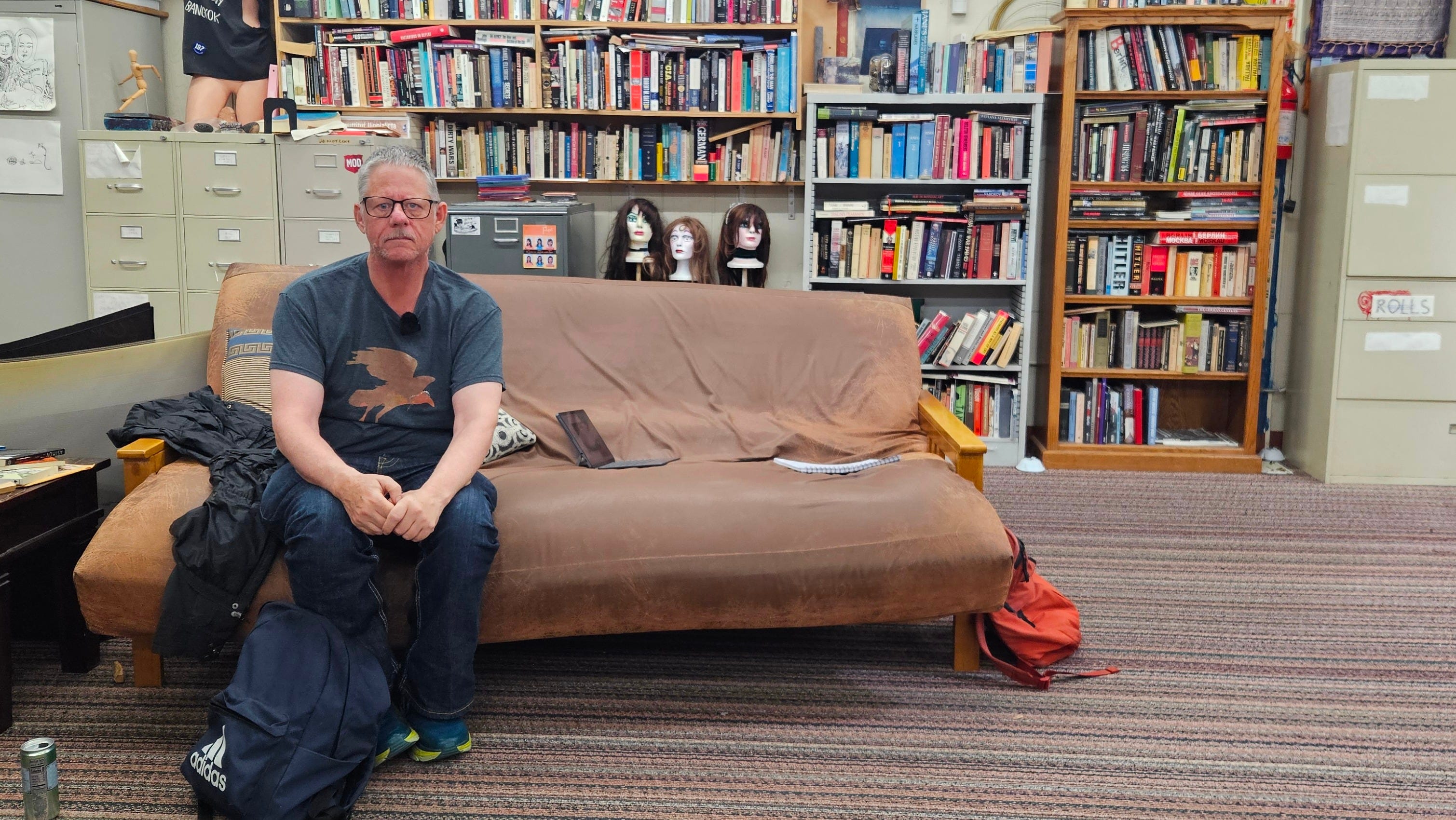
Vollmann twists and tugs free of his jacket and sits on the far end of a brown futon with faded leather. It’s bent more like a chair than a flat surface but not by much. He crashes at the studio for a couple days or a week at a time. I figure the futon is where he sleeps but later he shows me the bedroom: a lamplit room with a bare white mattress with a crumpled sheet next to the meat cooler.
There’s a MENS and WOMENS restroom door and he’s painted naked people on both. One has a shower, and the other a toilet, and above the toilet are six tall black-and-white photo prints showing topless women and a muscular cross-dresser looking pretty, stern, strong, lonesome on a bar’s corner stool.
On the futon he sets the Pellegrino at his foot and leans back, legs crossed, while I set up my recording equipment: a Chromebook on the seat between us, recording just for backup audio, and a lav mic clipped to his collar. Arms in his lap, crossed at the wrist.
We talk a little more about Cuba, the piece he’s writing, each involving oil and Donald Trump. I’ve been following Vollmann’s work for twenty years and never heard him speak in the recent register. Peppered through conversation are nasal-earnest invocations of “the founders,” pledges to the effect of “I love our country,” the exhortation of “soft power” that America once exuded around the globe and that Trump, singlehandedly, has squandered: cuts to foreign aid, threats and insults to allies, persecution of minorities. “As Franklin said: ‘Rebellion against tyrants is obedience to God.’ And I hope we rebel against this sacka shit.”
His left hand drifts and stands on its fingers beside the Chromebook like a spider.
Over the next two hours it’s the only part of his body in the shot.
“This is the end.” The characteristic irreverence gone from his voice. “This is the end of America as we know it.”
If things are going to change, he says, the first thing that has to happen in America is we all need to establish a set of foundational truths. Measurable things about the world that everyone can agree on.
“Did you ever see this book, The Commissar Vanishes?” He sits up and glances over his shoulder, scoots forward on the futon. “Let me see.” Curls and pushes himself up. His gait’s a little stiff. “I might have it right here…” Circling the futon, tilting at the waist, he scans his bookcases. They’re packed and flooded. Paperback spines say CIA in different decades’ typefaces. The nicer hardcover tomes isolated in a tall skinny case. Names like HITLER and STALIN and LENIN float like gnats among the shelves. I ask if these make the brickwork of A Table for Fortune.
“Uh,” snapping upright and doubletaking to see which ones I’m looking at, “there’s–” short of breath, preoccupied, “[some] were for Rising Up and Rising Down, um,” bending again, “darn it,” scanning titles with his finger now but hastier, “gimme one more sec to look,” zeroing in, “I’m pretty fried,” but after a beat he seems to pass it up, “anyway,” still looking at the shelves but sorta drifting back toward the futon, “it’s all…before-and-after Stalinist pictures,” but then he pauses again. Stares hard at the shelves. “I’m sure it’s here, so…yeah gimme one more second cuz I’d like to show you…” Head cocked. Little flicks of his nose show where he’s looking.
He doesn’t find it.
“Sorry.” Drops down on the futon. “That’s how I am now. I’m just a very stupid old thing,” chuckling about it, “oh well,” but the chuckle is a neat ha ha, spoken like words, “so it goes,” folding himself into the earlier position. Tense as he holds it. Like he might actually jump back up and keep looking. He explains that the book shows a sequence of photos, spanning decades: the first is Lenin with four lieutenants. One of them gets purged. So the next photo is Lenin with three lieutenants. Finally it’s a photo of Lenin standing by himself.
An hour later, a dozen topics down the line, he’s telling me about “this chemo mind thing,” how it isn’t just confined to the period of your treatment. That he hasn’t quite recovered from it. He touches his face, “The way I’m bumbling around,” and throws another crooked glance at the shelf, “I should be able to find that book The Commissar Vanishes,” his tone gets a flash of severity, “it’s probably right here,” and then relaxes.
“It’s just,” then a small pause, a breath, “I’m that way more and more.”
When we get to talking about the new novel I mention I’ve only read “most of two volumes” and Vollmann says, “Oh!” He nods once, at a table across the room. Stares at it. “Good for you.”
One aspect of US foreign policy he was most excited to explore, with A Table for Fortune, was American meddling in Angola during the Cold War. The CIA facilitated armaments and aid to revolutionary groups fighting the Russians, double-dealing in some cases; the goal, as he puts it, was to simply “bleed” the Russians. Exhaust their resources. Keep them overwhelmed.
“If you’ve read the first two volumes,” he tells me at the half-hour point, “then you know about Gerald Bull,” i.e., the Canadian engineer who designed weapons during the Cold War; he’s described, on NASA’s website, as “the most brilliant artillery scientist of the twentieth century.”
Vollmann, invoking the name, pauses to let me nod my assent.
Which I do. But I hedge. “Well so I, I, I…” and clarify that I read Volume One, or I mean part of Volume One, to get a sense of what the father’s life is like, and then jumped to—and again: only half—I jumped from Volume One to Volume Three.
“Oh!” He rolls his head forward. “OK. Alright.” Stares at the long table piled with books. “Well.” Looks my way. “That’s probably good enough, huh?”


“In twenty-twenty-twooo,” like he’s climbing down into the memory, “Lisa died, Viking fired me, and—for some reason I don’t understand—Ohio State fired me.” The school had been buying his manuscripts. That amounted to “ten thousand a year…less twenty percent for my manuscript dealer.”
We sit with that a moment. I’m thinking back to the profile I wrote last year. Trying to remember if he’s reciting these losses by sequence or scale.
“You got hit by a car, too, right?”
“Yeah that too.”
He’d worked on A Table for Fortune nearly 20 years when Viking severed ties. It was supposed to be the third installment of a three-book deal. They realized, while closing the contract, that they’d already paid him some of what he was owed for this final novel. “They didn’t make me pay that money back.” His nod is slow and gracious. “They were very nice.” After that Susan Golomb shopped the novel around. New York Review Books was interested, but they weren’t willing to assume full legal liability in case some of the living people that Vollmann depicts as characters in the novel decided to sue.
Arcade said sure.
He sold them the book for $10,000.
The way he’s looking to stay afloat now is how he’s done it since the ‘90s: journalism. More often, in the past, it involved trekking out to dangerous places. He often got detained for hours at a time but thought that was fine. He was being paid to visit and write about a place that was difficult to get into and difficult to get out of.
Lately he’s reporting more from the study. Reviews of the new Thomas Pynchon novel, the new James Ellroy, the Library of America edition of John Quincy Adams’ diaries. A 2024 article in The Spectator called “My Friends Who Vote Trump” seemed to circulate wider than others.
I ask about those friends (“good people who I love,” as he calls them, “who think differently”) and how to have a constructive conversation about politics when, as he points out, the crux of their allegiance to Trump is generally that they’re patriotic, they’re worried about something, and they’re misinformed. The prospect of alienating those everyday Trump voters is the only thing that’s given him pause in “stepping up [his] venom against Trump.”
“He certainly deserves it. I think he’s an evil stupid person who’s a calamity for our country and for the world. But what I don’t want is for my friends who love him to decide, ‘See we knew all along that Bill never should have been our friend.’ […] I want to keep the lines of communication open. If and when I can’t do that, then that’s when Trump has won.”
I ask if those friends, who might lapse into thinking he was never really their friend, are familiar with the “nature” of his work.
“Well.” He takes a deep patient breath and looks around. “Y’know, uh, you’re an intelligent guy, and you’re hardworking, and yet, y’know, you didn’t have enough time to get through A Table for Fortune.”
While reporting on Vollmann last year I asked some of his friends how he reacted to Lisa’s death. They said they either didn’t know or weren’t in a position to talk about it. “You can imagine,” they’d say. “Guy lost his daughter.”
“I did kinda go dark just because…depression is very tiring. My friends would call and it might take me three or four days to force myself to pick up the phone and talk to them.”
What he did was lay in bed and stare at the wall. He read a lot. He thought about A Table for Fortune. “I’m not a naturally social person. I like people. And being a journalist has helped me fake being an extrovert. I enjoy talking to you. I enjoy listening to people. But I’m not like a public person [by] choice. And that’s a good thing. That’s why I didn’t feel so bad when it seemed like A Table for Fortune wouldn’t get published.”
“What were you reading in your grief?”
He brightens. Pale ridge high. “Lotsa sci-fi!”
Emphasis on the last part, like marines with their mantra.


His voice has the gravel people get when they’ve been awake either a very long time or not much time at all. I’m packing up my materials and Vollmann invites me to lunch at a barbecue place nearby. He stuffs his jacket into his bag but doesn’t zip it all the way. I notice he’s holding my Pellegrino can from earlier. I make a mortified noise and then look hard at my phone. It tells me that the SUV-style Mustang has pulled up and parked across the street.
I look up, squinting, and spot it.
When I point it out to Vollmann and he joins me on the sidewalk, I glance at his hand: the can is gone.
We start crossing the street but stagger back as a car cuts by, nearly grazing us.
It scares me a lot. I try to sound calm and droll. I say, “Where’d you get hit by that car, by the way?”
Vollmann stiff-arm points at a spot about twelve feet away. “Right there.”
We approach the Mustang from opposite sides and try to get in but the doors have no handles, only a very discreet button, roughly the size of a nickel, set flush inside the door, with a nipplesome light at the center to make it stand out. Hard to see on a black car in peak sunlight. And so we stand there like mimes: patting, poking, pressing our respective doors. This one pops first. I jump inside and say hi to the driver and lean across the backseat to open Vollmann’s—but there’s no discernible handle on the inside either, maybe it’s just my eyes adjusting from the sunlight to the black-on-black interior, so again I’m fumbling, slapping around, asking the driver what’s happening while he twists in his seat and looks back over his shoulder and says, “Yeah,” clicks his tongue, “it’s not easy…”
I find a latch like what normal cars use for automatic windows and the door juts out in its frame. Vollmann claws his fingers into the gap and pulls it open, “Hey!” Cheery. “Sorry about that,” curling into the seat, shimmying out of his backpack. “I was too stupid to get the door open.” A pep in his voice.
(Just a stupid old thing.)
Zips the seatbelt across his chest and clicks it home. Leans at the driver, “How are you today?”
The driver’s name is Carlos. Carlos says, “I can’t complain.”
“How many fares have you had?”
“Six or seven.”
Vollmann nods, “Oh oh-kay,” like he’d heard a rumor it was three, “and where are you from?”
“Puerto Rico.”
“Oh! My friend Alex here’s a Cuban guy, he’s from Miami.”
Carlos says he lived in Miami for a while after Hurricane Maria. He wanted to be closer with his family. “I’m an electrician.”
Vollmann pinches his top lip and wiggles it and lets it go. He scratches his fuzzy haircut and rocks in the seat. Drags his fingers over both eyes like warpaint. “OK Carlos. Hey:” He explains that there’s a transformer in his neighborhood that keeps exploding.
We’re pulling up to the restaurant now. Carlos starts slowing down, but doesn’t stop. He’s explaining why transformers explode. “First it’s just flat and dead,” a horizontal karate chop through the air, “there’s no power at all, and then suddenly, what happens, is there’s a latta power,” simulating currents in the air with wiggly fingers, “and then it blows up.”
Vollmann’s nodding, saying uh huh, fondling for the doorhandle like braille.
“And then,” says Carlos, “there’s big spaaarks, and blue liiights, and there’s smoooke…”
Vollmann finds the latch, “Yeah,” clicks the door open, “that’s what happens when I kiss my girlfriend,” and then hurls himself out of the car while Carlos cackles, claps his hands, rocks in his chair.
The restaurant is fast-casual. Standing in line, we study the menu. Vollmann tells me about the smoked porkbelly: how they shape it into cubes, and then cook it in a smoker for two hours, and then they take it out of the smoker, and they glaze it with honey, and barbecue sauce, and brown sugar—and then they put it back in the smoker for another couple hours.
He explains it in a purr, with lathering gestures, like a woman once did this to him and it was great.
Pop music plays from an overhead system and there are televisions in the back of the restaurant playing World Cup coverage and William T. Vollmann orders the smoked porkbelly with onion rings and a beer. I get a salad with turkey. When the cashier asks if we’d like anything else Vollmann tells her yes, and puts his chest out, gets his shoulder next to mine as in a lineup: “Which one of us is more handsome?”
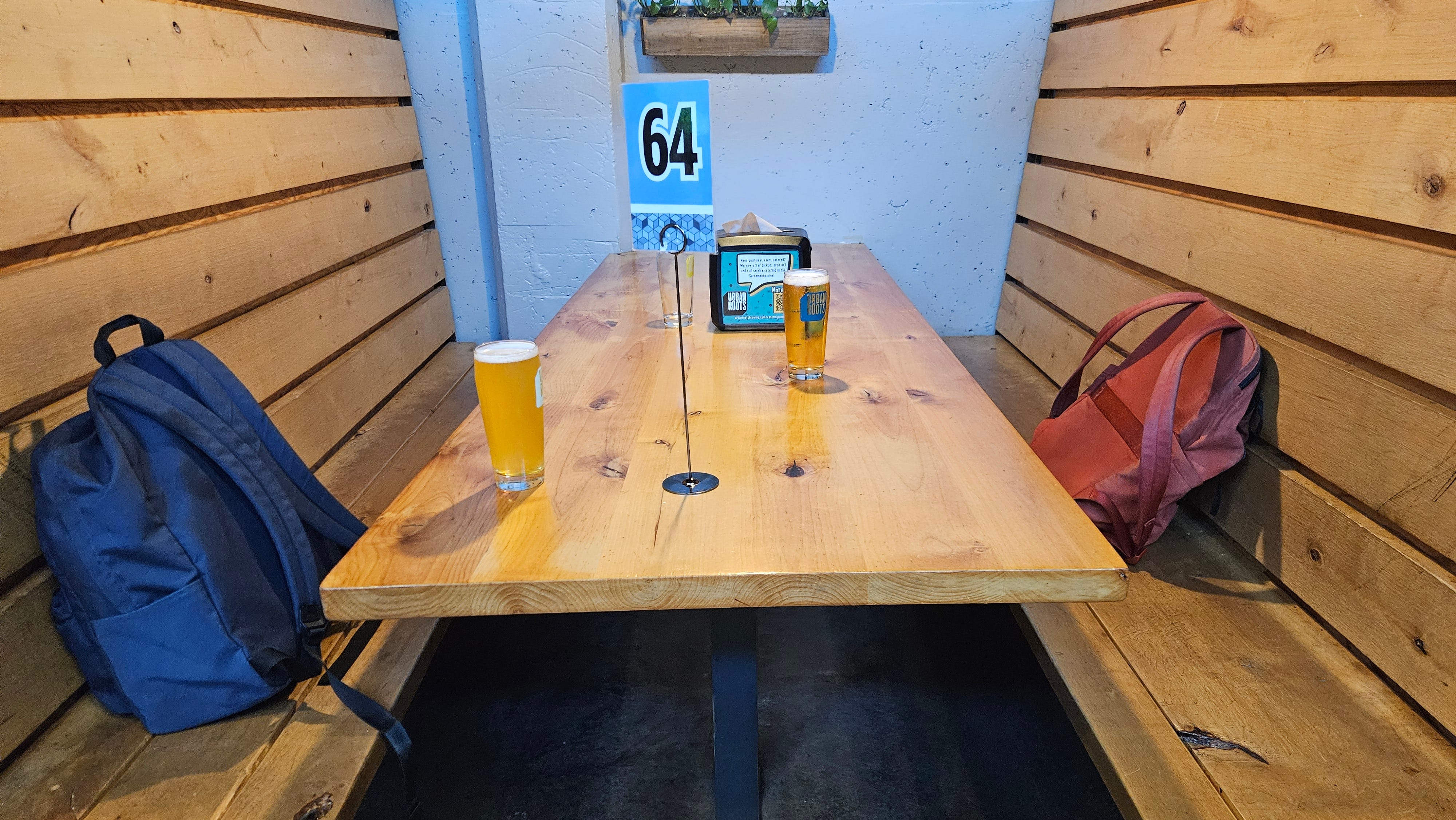
He gets our beers from the bar and picks a booth. Puts the beers down. Limps to the self-serve station. Comes back with two little cups of barbecue sauce. He tells me there’s this one sauce that’s sooo spicy, they keep it stashed behind the bar, so people don’t hurt themselves. You have to ask for it. But he emphasizes: it’s reeeaaally really good (if you like that stuff).
I ask if he has suffered any dietary restrictions since having a length of intestine removed. He concedes with a frown that yes: he can no longer eat that sauce behind the bar.
He’s in a t-shirt with his elbows on the table and head tilted boyishly. Shoulders as narrow as his early author photos. We touch on Lisa. He explains the lethal braiding of bulimia and alcoholism. How they attack different organs simultaneously. The online communities that foster eating disorders.
A waitress comes with our food on a tray.
Vollmann leans back fast: “Hello, barbecue goddess!”
She sets the food down and walks away. Vollmann singles out his porkbelly, his onion rings; sets them in front of himself and before taking a bite he tilts them at me. Doesn’t just invite me to taste it but asks me, with a please.
We talk a little more about places. Miami and Sacramento. Iran and Cuba. He sips his beer. Twists in his seat. Bows his head and drums his fingers back and forth over fuzz. I’ve read that he has a few nervous tics but he looks a bit like someone bobbing along through pain.
We’re talking about A Table for Fortune. He says he hopes I’ll finish the book.
He chews porkbelly and sips beer and pulls at his face. Slaps at the fuzz on his head.
Then he settles. Some flash of serenity like a drug finally hitting. “I feel really good about this, Alex.” Like he’s been relieved of something.
We speculate about its reception. Who will read it and who won’t. He reiterates his point from before, about gratitude. All the people who read early drafts. His tireless young editor, Isaac Morris (“I hate to think how many times he must have read it”), all these people who paid him such a “tremendous favor” by vetting the manuscript for errors.
His tone is all retrospect. Like A Table for Fortune concludes, to his liking, something larger than itself.
“Do you intend to keep writing…at risk of leaving things unfinished?”
“Y’know, I’m not really worried about it. One way or the other. I’m just so grateful I was able to finish A Table for Fortune. When we die we always leave things unfinished.”
Vollmann shifts in his seat. Grabs an onion ring and dunks it in ranch dressing nearly up to his fingertips. “So Alex,” voice perking, letting that onion ring soak, “tell me what you love the most about your girlfriend.”

My thanks to Isaac Morris, Tony Forde, paid subscribers (including my parents!) and William T. Vollmann for their help and support. This piece was independently reported and self-financed. If you value work like this please consider becoming a paid subscriber.
What a life. Great interview.
Man, that was some special sauce and I didn't even have to ask for it. Delicious with earthy overtones of life's required sadness.