Vagabond Believers
On Meaghan Garvey's terrific new book and its haunted personal vibes.

1.
People say retirement communities in Florida are famously replete with venereal disease while others say no, our elderly do not do this, it is local apocrypha, there is no evidence.
Cowards’ rebukes. It’s a longheld truth (allegedly) that elderly, affluent, conservative swingers in central Florida are putting differently-colored loufas on their cars as a code. Each color corresponds to a sex act they enjoy. The loofas constitute a possible invitation to fellow pensioners; a message direct from the Chevy antennae of Bert and Ethel: pad your joints, and seek moisture.
The story is out there. I choose to believe it.
Cynics are welcome to gripe about evidence, fine, but hope is the essence of inquiry, and Fox Mulder teaches that “belief” is the endpoint of desire; seek not the little gray man in the sky, but the cavern within ye that He may fill. (Loofa color: white.)
2.
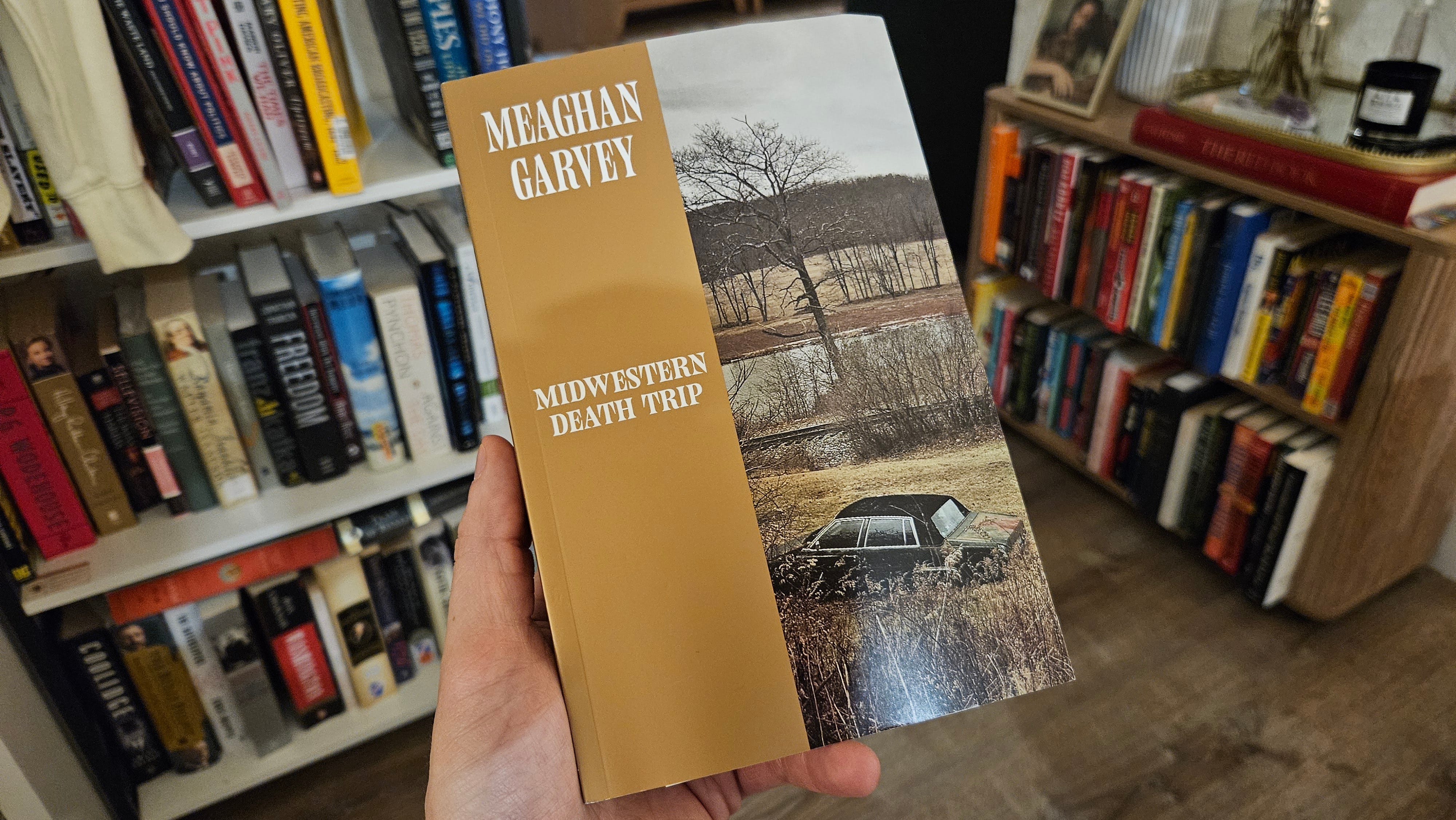
Two weeks ago I read Meaghan Garvey’s new book Midwestern Death Trip and loved it. She’s a Substacker with a popular newsletter called SCARY COOL SAD GOODBYE where she tells about her experiences at various dive bars in the Midwest.
The book is unique because the fractured newsletter-ish composite of scenes suggests quick episodic reading (and it's good for exactly that kind of reading) but the scenes accrue to some larger and weirdly shattering experience.
There’s an attesting thesis, too, covered in swamp water but manifest in real-life and mythic characters like an “eccentric” scrap collector:
[Tom] Every sensed a spirit in the objects he salvaged, believing that the machinery was animated by those who used or made it…From his collection of salvage, he began building the Forevertron, a 300-ton collage of repurposed wreckage that would become the largest (then second-largest) scrap-metal sculpture in the world. It’s purpose, he half-joked…was “to perpetuate me into heaven in a glass ball inside a copper egg on a magnetic lightning force beam.”
Garvey’s memoir-esque book where the narrator barhops through small-town dives, gabbing with eccentrics and asking after local history, fixates on people like this: eccentrics whose projects make zero sense to anyone but themselves. But they follow through. They don't nurture their ambition any less for the fact that, to everyone else, it looks like fucking up.
3.
One thing I didn’t like about the book is this: when dropping us into a new town, it tries to cultivate a feeling of history, right away, with half-page passages that start like this:
Within Calvary Cemetery’s 92 acres of lakefront burial grounds lie more than 219,000 interments since 1859, among them six Chicago mayors, the founding owner of the White Sox, and the man who designed the city’s grid street system.
Sentences like this feel motion-sick: you skate forward over words without advancing. “Mayors” is a word that I know. It is a noun that means “elected city official.” But it doesn’t put an image in my head.
“Chicago mayor”? Sorta.
But “six Chicago mayors”? How about “burial ground” or “interments” or “founding owner of the White Sox”?
I understand what these words signify but the calories are empty.
And yet, in a weird way, they’re thematically pertinent.
That sentence about Calvary Cemetery is teeming with people (mayors especially), all of them lived public lives and did things, but all of them—to us in the future—are anonymous. Placeholders where names would be.
Such are the people Garvey’s out here engaging, interviewing, celebrating, immortalizing: residents of forgotten towns with double- or triple-digit populations. They get together and they drink and they know each other’s hangups and botched dreams and weaknesses.
It feels at times like the thing that bonds them best is that they don't have anyone else.
4.
In my twenties I had a vagabond period: drinking and wandering and talking with strangers in bars, usually old men with narrow shoulders and long bellies who hadn’t been asked a question in ages and thus they told you everything.
One time when I was 23 or 24 I was reading American Pastoral at the Miller’s Ale House in Pinecrest when this late-50s couple started laughing it up, really blitzed, she was older than him by a few years and they were celebrating her retirement.
Twenyodd years as an RN at a women’s prison.
I wasn’t good at talking so I would just ask people questions and they’d volunteer stories like this one:
This now-retired nurse had only been working at the prison a few weeks when an inmate got dragged in by a CO, needing some sort of life-saving maneuver, whereupon the nurse got quickly to work; fresh with newcomer nerves, looking just to make conversation with the CO, she asked what this woman was in prison for. The officer said that this prisoner learned that her husband had cheated on her and so she packed a suitcase while he slept, stole his car, and right on the kitchen counter, where he normally sat himself down for breakfast each morning, she’d left him their newborn child microwaved on a plate.
Brushing her palms with a steep frown: “I said: if I’m ever gonna do my job the way I need to do my job I gotta never ask that fucking question again.”
I didn’t know what to say about that story, so that’s what I said.
She shrugged, “Yeah but that kinda thing,” shitfaced in her 60s, “you get used to it…”
5.
Garvey talks with a guy at a bar. He’s vague about his job. But he says it granted him entree to some awesome parties with beautiful women and all the booze he could drink. She presses the question of what he does. He reveals that he did pest control for billionaire human-trafficker Jeffrey Epstein.
Later in the book Garvey meets a guy who seems pretty serious and principled and kinda self-importantly upright. But he’s closed-off. This guy’s got a secret. As he loosens up over whisky and wine we get a sense he’s going to reveal what that secret is. Like everything else in the book it will surely be a bit lurid and eccentric but ultimately human.
And so we’re getting there: in a crescendo moment that the story’s been bubbling toward (masterfully) for the past several pages we suddenly learn that he is simply your average small-town, middle-age, mid-western superfan of Adolf Hitler.
There is shock, but then the shock turns flaccid. The radical ideology, in this man's handling, feels inert. Pathetic. A floatation device shaped like a dagger.
The racy story drops its excitement and just feels soiling. Suggests an American ultimatum: to keep your head above water, you either create something clean and weird, and let it float you, or find some pre-floating thing, however filthy, and grab on.
The charming curios of the book’s first 1/3 accrue a strange grime that feels very deliberate and measured and ultimately, if you give yourself over without judgement, moving. A bildungsroman for those of us who came a little late to bildungsing our romans.
6.
Garvey takes these people as they present themselves, no worship or condescension. Occasionally drawing back to set the scene.
The bar was packed tonight with a heady mix of wide-eyed men and lizard women who seemed as if they might disappear into a puff of smoke the moment they set foot outside the blood-red room. I felt happiest in rooms like these, where strangers outdid one another with their outrageous lies.
There’s a little romance, yeah, but it’s tempered.
That’s the vibe of a scene where she and an Elvis impersonator named Alvis proceed to talk about the King’s career in such a way that they realize, without having to say it, that Elvis with his talent and his promising youth and his precipitous decline into fatty oblivion, at the end of the day, was one of them.
Writing of these years, when she felt like such a failure, Garvey describes finding her late mother’s diary. She reads an excerpt from September ‘93:
I never pursued a career in writing, yet, as I can remember, that was where my passion lay. I have always used the excuse that I became what others wanted me to be, but I think now that that is and was merely rationalization on my part. I think I feared failure—a great risk in artistic endeavors.
7.
In a book filled with eccentrics she manages to convey her own eccentricities without championing them, or holding them up to anyone else’s. There’s a scene in Midwestern Death Trip featuring a body bag and it is one of maybe five passages I’ve ever read in a book that got me choked up. Last time that happened I was reading about Columbine.
What you start to notice meanwhile is that excitement and variety don’t lend to a life in which many things can take root, and grow, except perhaps for a longing that they would.
Midwestern Death Trip belongs to that rare subset of books whose artistry, sentence by sentence, is so discreet, so understated, it feels less like a text than like company. Nothing seems embellished but a lot of the material is stranger than fiction and I don’t doubt some will harp that the stories aren’t true, she made it all up, but man that’s the point of the bar: the truth is what you want to believe, even about yourself.
PS
Thanks to the support of paid subscribers I’m leaving Miami this week to interview William T. Vollmann at his studio in Sacramento. I’m not great at the “chat” function, but I’m planning to get savvy, and over the course of the trip I’ll be chiming in there for updates/chats with paid subscribers.
If you’d like to support the trip, and deep-diving literary journalism, please consider becoming a paid subscriber.
I'm about 10% of the way into this book and loving it; sounds like I'm in for a treat.
love it. thank you for reading