
This is the first installment of a three-part series.
Jay McInerney would later say of the Literary Brat Pack, a cohort of twentysomething fiction writers with flashy debuts in the mid-1980s, that “I had less to gain” than the rest of them because “I was the one who’d been there first,” meaning it was his own book, Bright Lights, Big City (Vintage Contemporaries, 182 pages), that established the trend of taking a lurid, minimalist, autofictional novel by a young person and selling it as something more than a book, as a cultural event, the blooming of a generational “voice.”
The books were more diverse than the media of the time would suggest; they were fewer, too, occupying more discourse than shelf space. What they had in common was a minimalist style, a casual invocation of brand-name products, and lots of pop-culture references (especially toward music and TV). They were usually pretty candid about sex.
David Leavitt’s collection Family Dancing (Alfred A. Knopf, 205 pages) had come out a couple months prior to McInerney’s book, and it did well with readers and critics, but it didn’t explode in the way that Bright Lights did. It didn’t turn the author himself into a paparazzi darling. While other authors were photographed brooding over cigarettes at lonesome cafe tables, Jay McInerney was handed a sword and photographed airborne for the cover of Esquire. Paramount Pictures asked him to write a screenplay adapting his novel into a Tom Cruise vehicle and then asked him to take Tom Cruise around New York, giving him tips, expounding on the material, Tom Cruise saying “yes sir” and “thank you sir.” By 1985 he’s being courted by producers of a new CBS news program called West 57th, a sort of MTV-adjacent version of 60 Minutes, whose hour-long pilot, in September of ‘85, features long-form reporting on
a philanthropic trip to Ethiopia,
the shortage of space available in battered women shelters,
Chuck Norris.
Promoting his second novel Ransom, in 1985, McInerney seemed in awe of the fame he’d achieved in just the past year, telling an interviewer he couldn’t believe he’d been given the privilege of interviewing Mick Jagger for Esquire, and also that “I don’t think writers should be modeling clothes next to rock stars.”
Yet here he is.
McInerney was still broke at the time he sold the novel, living in Syracuse and “mainly supported by his wife,” Merry McInerney (a line that would pop back up to haunt him for decades); he was just wrapping up his MFA, where he’d studied with the short story writer Raymond Carver. Newly sober, digging his elder-statesman status, Carver said that Jay had talent, sure, but lotsa kids have talent; what set Jay apart from them, he said, was work ethic.
Which explains how the book got written: McInerney submitted a short story to The Paris Review and, as he tells it, got a call from editor George Plimpton who said he liked it but, y’know…have you got something else? So he went through his desk and found a scrap of paper on which he’d written a couple lines in the second person. Built a story around it. Sent it to George.
George said sure. Published it.
Jay went on thinking about the story and said, There’s more to this.
Wrote a whole novel in six weeks.
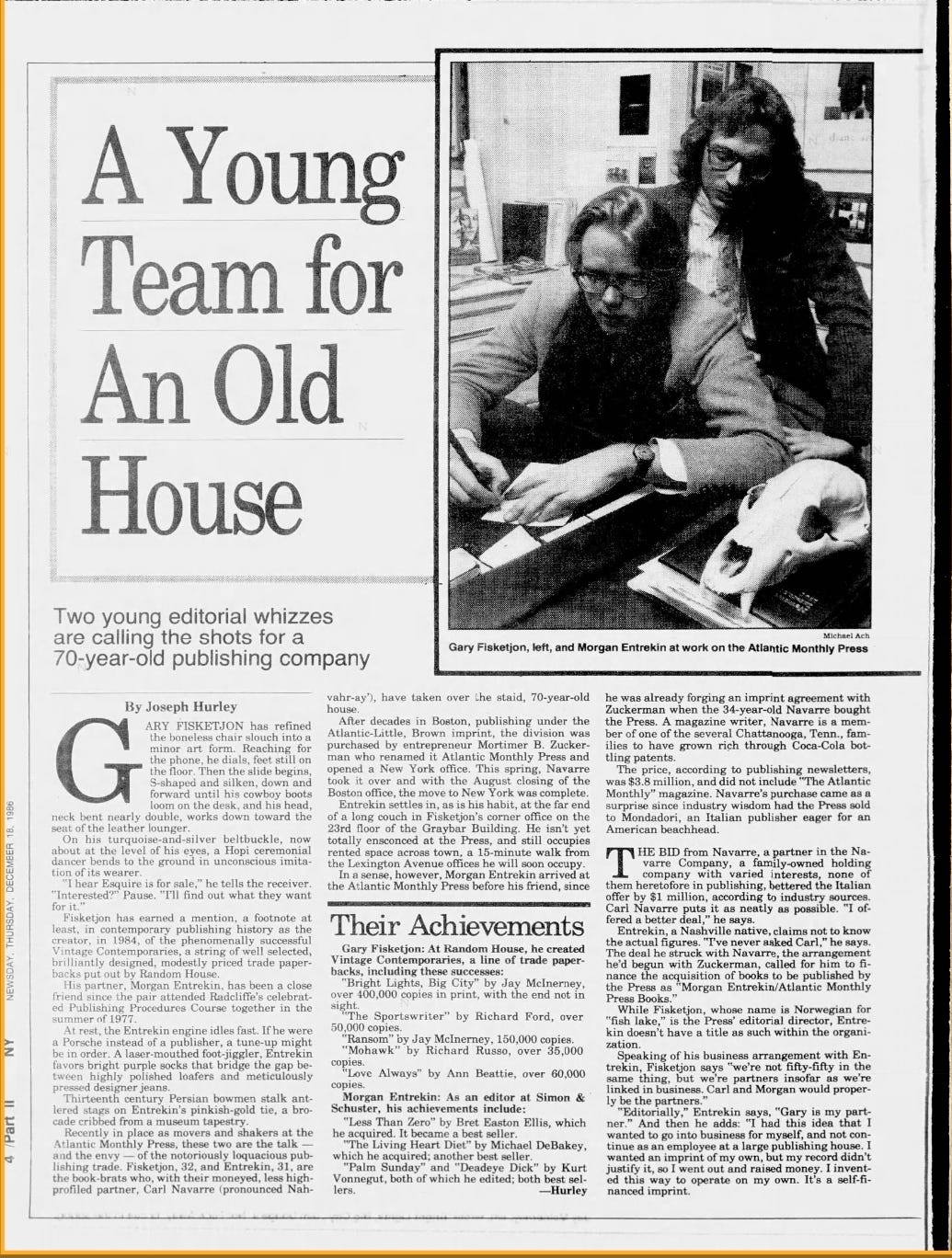
Sold it to his “editor and best friend” Gary Fisketjon at Random House. Technically Vintage Books. But Fisketjon was pioneering something: within Vintage Books he’d run a new imprint, Vintage Contemporaries, slim paperbacks with a uniform design that’d line up nicely on a shelf.
He wanted Bright Lights, Big City to be their flagship title.
Fisketjon wore cowboy boots and lots of denim. Belt buckles with western-themed images. His desk was neat but not exactly clean cuz he liked to have his boots up there. An enterprising Newsday reporter once caught Fisketjon smiling and said he looked like “a twelve-year-old mogul” and also noticed he is a larger presence behind his desk than on his feet.
Jay was thrilled at the offer.
Then Gary added that the book would go straight to paperback. No hardcover.
Jay quit his thrill.
Gary turning big-sigh paternal now, dismounting his horse and standing there hip-jutted in the 5th-avenue dust, he said listen: “a lot of people [will] take a chance on a book for six bucks who wouldn’t if it cost twelve.”
Jay relented.
Gary proved right
Even on those terms it didn’t look promising to the higher-ups. The book was lean and brisk and filled with gorgeous young people having sex and snorting coke. The author was charismatic and looked like a Kennedy. Seems like a sure thing in hindsight but at the time it looked…kinda shallow. Almost experimental with the whole second-person perspective thing.
On top of that, shortly before publication, it started to seem like a liability. McInerney got a call from a Random House lawyer, paging through the manuscript, just curious about this place “Odeon” the characters go to, where they bop into the bathroom and snort coke: You made that place up, right?
Jay told him no, it’s real.
“And he just lost his shit.”
Yeah because, as the lawyer explained, the fact that it’s a novel doesn’t make it any less an allegation of abetting illegal drug use. “They’ll sue us.”
Jay said, “Nah, I don’t really think so.”
Alright well the Odeon was owned by three people, one of them was named Keith McNally, and Fisketjon said to Jay, look, you oughta go there and tell them anyway about the cover (a broody Edward Hopper-type illustration of the Odeon itself; World Trade Center jutting up in the backdrop), so just set up a meeting with Keith, make sure he knows what’s going on.
Jay said sure. Met with Keith McNally. Showed him a poster of the cover art. Explained the content: young people, drifting through the city, one’s a fact-checker, his heart’s broken, and they snort coke in your bathroom.
Keith told him, “Great. No problem.”
“[Jay] made some terrible jokes that were very unfunny,” McNally later told Vanity Fair, in a 2005 oral history. “And so I just thought he was talentless” and that his novel would “never see the light of day.”
Well it did. And it was covered everywhere. Radio, print, TV.
And meanwhile in the Christmas issue of that year’s New Yorker, where McInerney enjoyed the brief stint that brought his novel to life, there was a short story called “Slaves of New York” by a young author named Tama Janowitz whose debut novel, American Dad (G.P. Putnam’s Sons, 264 pages) was a commercial flop, back in ‘81, and then she wrote another couple novels that couldn’t get published—finally she started writing short stories because, as she told Molly Ringwald, “I [could] get them rejected much quicker.”
That was the answer she’d honed over time.
Speaking more earnestly, at the time, she said, “I still consider myself a novelist, but I stopped writing novels because I couldn’t get them published, and it would mean, like, a year of my life gone. Short stories didn’t take as long to write.”
The New Yorker published five of her stories over the next two years—but Crown Publishers had gotten in touch with her agent long before then. They wanted to do a collection. Tama said sure. When the book was in galleys she got some pamphlets printed out, containing one or two stories. She bustled into various fine dining restaurants and high-price retail spots. She wore a bright silver coat.
Four Seasons.
Lutece.
Oyster Bar.
Gucci.
She handed out excerpts, announcing her new book, telling people they should buy it. Trailed by two friends, the “slaves,” one of whom, according to the Daily News, “wore [a] glittering gem-studded Statue of Liberty jacket,” while the other “wore a lime green Stephen Sprouse jumper she got at the designer’s Chapter 11 sale.”
She was loud and vivid, creative, she refused to be ignored and when the staff at these places approached and told her she was disrupting their business and asked her to please leave she said yes.
Meanwhile at a liberal arts college in Vermont the writer Joe McGinniss noticed a young talent in one of his writing classes, Bret Easton Ellis, who’d written a couple of books already, as a kid, the first one about a boy who gets turned into a pancake and then a slightly more earnest one about the summer he was fourteen, and his mom found pot in his room, and so he had to go stay and work at one of the “creepy hotels” his grandfather owned, out in Elko, NV. But he’s been kinda sorta working on something for a couple years at this point. It’s not that cohesive at the moment. Just “scenes,” basically. Narrativized journal entries he’d kept in the latter part of high school about things he’d gotten up to with friends. Dramatizing it. Exaggerating. Fictionalizing.
During his school's Field Work Term (FWT), when students are supposed to spend six to seven weeks in the winter getting internships or jobs that correspond to their field of study, Bret went home and wrote a short novel that pulled those scenes together into a narrative.
McGinniss passes the book along to his personal agent, Sterling Lord, and an editor at Simon & Schuster named Morgan Entrekin. Lord takes him on as a client, Entrekin acquires the book for S&S, and an editor named Robert Asahina takes it over, starts pulling it into shape.
As with Bright Lights, Big City, the publisher doesn’t throw a party for it: slim, niche, explicit—it’s not getting a party if it doesn’t even have an advertising budget. That seems to’ve been one of the handshake terms of the acquisition. When Entrekin sent the manuscript around the office, and editors wrote their impressions on a cover sheet for everyone to see, Herman Gollob wrote, “If there’s a market for callow, fragmentary fiction, about rich, self-indulgent, coke-sniffing, cock-sucking zombies, then let’s buy it.”
But there’d be an understanding about the advertising budget (zero), a small printing (5,000 copies), with a small advance ($5,000).
Less Than Zero (Simon & Schuster, 208 pages) comes out May 1985.
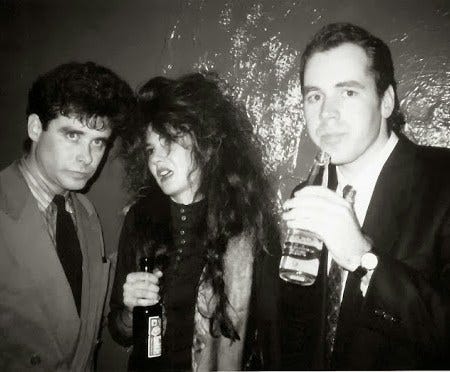
He finally got a party in September once the book had taken off and there were 60,000 copies in print and Bret, along with Bob Asahina and some other folks from publishing, celebrated at a club called Limelight. Tama describes it in her 2016 memoir as “an old church that had been converted into a nightclub” and remembers being there with Andy Warhol one night
and it was crowded and we were walking up the stairs and Andy was in the middle and suddenly as a group we realized: Andy was about to be attacked. We felt the waves of hostility coming toward him and we knew the crowd was about to shove and push and knock him down the stairs. . . [so] we all packed up around him and got him up the stairs. . . .Those waves of heat and violence coming at him were scary.
Andy Warhol was accustomed to this kinda thing by the mid-1980s. “He acted oblivious to it,” Janowitz writes, but everybody knew it could happen after 1968. The playwright Valerie Solanas had written a play called Up Your Ass and wanted him to read it. Andy took it to his art studio, the Factory, but lost it. She kept calling to see what he thought but he didn’t know where it was. Finally she caught him on the sidewalk outside his studio one day and rode up the elevator with him and his assistant Jed Johnson. She wasn’t the strangest person he dealt with. Stood tense and fidgety with a bag in hand but it’d be a while before its contents were itemized by police as an address book, a Beretta .32, and a Kotex. Warhol noticed she was wearing pants and a turtleneck and lots of makeup despite the heat. When they got inside the studio she shot him from a low angle. The bullet went into his belly and ricocheted through his torso and exited his left chest. They had to cut him open from so many directions. His abdomen afterward was about as strong as those glassine bags they put goldfish in at the fair. He had to wear a corset the rest of his life.
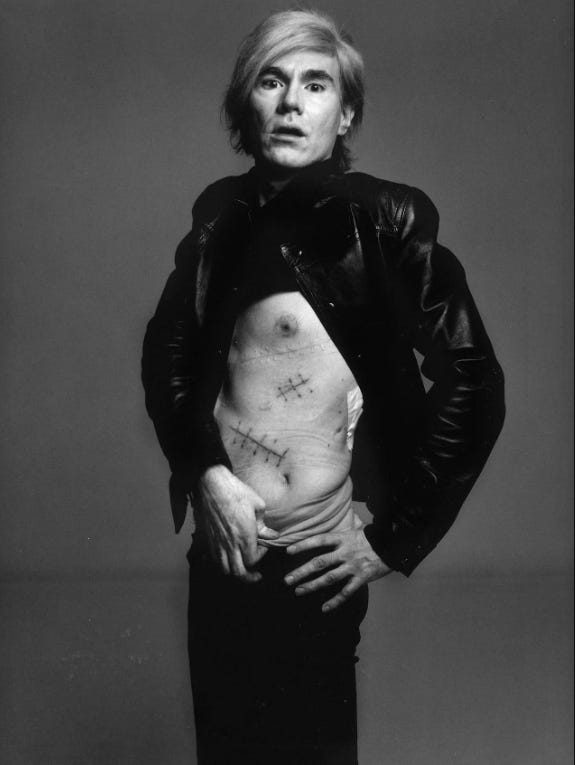
Tama was happy to be famous and get a little money for the first time in her life but she didn’t have the nerve for that kinda thing. To suffer what he suffered and then bounce right back into public life.
“If it were me,” she wrote in her memoir, “I would go home and I would cry and I would never go out again.”
At one point, as the stories were trickling out in the New Yorker, Andy said he wanted to make them into a movie. Tama said OK. He said he could either give her $5,000 (about $15,000 in 2026) or she could go around the studio and pick out a painting which, yeah, sounds real generous except that Tama had no place to stay, and probably wouldn’t have known what to do with the painting anyhow once she had it, and so she said fine, fuck it, gimme the five grand: “Because what was I going to do, with nowhere to live, walk around the streets of New York carrying a Warhol under my arm?”
She writes of Andy like he was a good friend but also a cautionary tale. A model for how you can get so famous you stop being a person in the public eye and more like an idea.
How people might come to just absolutely hate that idea.
Fortunately at Limelight it’s not that way. Reporters show up and Ellis is chainsmoking and drinking and doing a solid job of hiding his discomfort when a bunch of college kids turn up to have him sign their book, at a night club, in what even the photographer must have thought was a little too obvious; it’s like earlier in the summer, out in L.A. just after the book was released, Bret and some friends popped into Club SoHo for a drink (freshly 21) and got approached by a bunch of high school boys who recited to him, in unison, something they’d composed called “Ode to Bret.”
That was LA.
He’s trying to get away from there. Two more years of college and then he’s moving to the east coast. Starting over. Tall and lean in his Salvation Army suit, wide black necktie, the same lapel pin as his editor Robert Asahina, tilting in the direction of whomever he’s talking with, ear canted down to catch their voice over the music. A reporter quotes him saying that “the hype around [Less Than Zero] was more for my age than its literary merit,” but the article gives no context, doesn’t specify who he said it to, and it’s hard to imagine an editor seeing that quote, out of context, and not anticipating how it might get him in trouble.
But that’s the media and it’s part of his world now. Things aren’t what they seem. Michiko Kakutani in the Times said Less Than Zero is more like a 60 Minutes “documentary” (a word she used for Bright Lights, too) than a novel, that “the characters remain so alike in their aimlessness and disaffection that the reader has a pretty hard time of it telling them apart.” A first-time author might see that and feel discouraged. But more importantly she said that his book is “one of the most disturbing novels I’ve read in a long time” and honestly, for a book targeting teenagers, could the Times have given a compliment more valuable than that?
And anyway it’s just business. Just last week he reviewed a book himself in the Wall Street Journal. It’s called Rich Kids: America’s Youngest Heirs and Heiresses, saying, “Maybe it takes a rich kid to understand and relate to this book. And considering that it costs $18, maybe they are the only ones who will.”
Reporters are here at the belated launch. Daily News tries to stir the pot saying Jay McInerney snubbed him and skipped the party but, no, he was here for two hours, they got pictures together, Ellis saying this is my good friend, Jay McEnroe…
Someone allegedly invited David Letterman but he didn’t show up and y’know what? That’s fine. Cuz guess what else:
Bret Easton Ellis is now the first author to be interviewed by MTV.
The paperback rights sell for $99,000 to Gerald Howard at Penguin and the floppy neon trade softcover of Less Than Zero (Penguin, 208 pages) hits shelves three weeks ahead of Tama Janowitz’s Slaves of New York (Crown Publishers, 278 pages), which also—like Bret, but unlike Jay—gets a hardcover treatment but also—unlike either—gets an instant lavish launch at Petaluma, on 73rd and First, where the people from Crown have their own little table apart from the other guests and they ask Tama’s friend (have you met Tama’s friend) Andy Warhol to sit beside her, over here, which Andy agrees to do because yes they are friends but also he knows how these things work. Spends his days getting shuttled around. Movie premieres that he sleeps through and then, as Janowitz remembers in her memoir, perfume launches where the PR people hand you some cardstock with a stain on it and say, “Smell it Andy,” and then he smells it says it’s wonderful, he says everything is wonderful, and as a thank-you they hand him a bag full of expensive shit for free, because it’s his presence that’s more valuable to them than anything, his blessing, and so Andy sits with Tama, shoulder to shoulder, and when the photographer comes around Tama leans into him smiling a vulnerable girlish smile, so unlike the way she normally looks toward cameras, while Andy takes wide-eyed bites of a huge vanilla ice cream cone, and he’s kinda waiting for someone at the Crown table to acknowledge he’s one of their authors, that they’re publishing his Party Book next year, but nobody mentions it, and after all he’ll be dead when the Party Book finally hits shelves in ‘88.
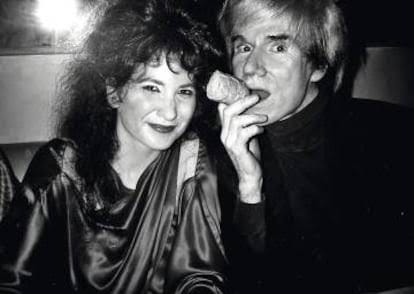
But look there’s Billy Norwich, as Andy calls him, whose Daily News column will report that the “restaurant was delightful and everyone’s outfit divine” but he wasn’t feeling great (“blame it on the full moon”) and so he leaves early. But Tama won’t dwell because here comes her “Texas millionaire boyfriend,” as Andy calls him. They’ve been seeing each other for a while now. They’re getting along and, to her own surprise, she’s pretty happy about that.
“This is so special to me,” she told a friend around that time, feeling lonely, “to go out, to get all dressed up and look forward to something.”
There’s promise here.
Everywhere.
They’ve all got a second novel sold. Bret’s for $200,000.
McInerney, at the end of 1985, is the first to release a second novel.
The reviews are savage.
“If this be the voice of a new generation,” writes David Remnick in The Washington Post, “then the generation is better off mute.”
To be continued next week…
PS
Same riff as you saw at the top: if you enjoyed this, please consider a paid subscription.
Next installment, next week, covers 1986—1987.
To be honest, I had no idea Warhol was actually shot. Wow. The story about Janowitz and Warhol reminded me of Fran Lebowitz. She knew Warhol and had a couple of his paintings. She decided to sell them when she needed some money (for rent or whatever). A week later, he died! She’s sure he did it just to spite her.
This captures the spirit of the era nicely. A bygone era it seems. Fiction just doesn't hold the same powerful sway as it did in the 80s. Those Vintage paperbacks were the bomb. Sometimes it's hard to believe that books were IT back then, next to music.
One thing to point out is how these writers captured the huge societal shifts underway post Sexual Revolution. Aimless, drug-addled youth who just a generation prior would have been married with kids already. This was a brand new genre of fiction.
I read all those books, and got on the fiction train to nowhere myself...
...to see that photo of male editors brings heaving waves of nostalgia for a better time. I was just thinking the other day about how the literary world once seemed like "my people" and now as I pore over agency bios and photos of millennial women sporting pronouns and political bromides it just makes my heart sink.
AMERICAN DAD is not good, by the way. Janowitz was a one hit wonder, perhaps more famous for her hair than her writing, but she did capture the zeitgeist.