No Power to Stop It
"The literary equivalent of Charles Manson." Robert A. Caro's epic, THE YEARS OF LYNDON JOHNSON, debuts.

Thanks for checking out the series! While each installment of this ongoing profile of Robert A. Caro, and his YEARS OF LYNDON JOHNSON biography, stand on their own, you’ll have more context if you go back to the first three installments.
About half of each essay is paywalled. If you like what you’re reading, I hope you’ll help the effort by upgrading to a paid membership.
Part Four
No Power to Stop It
The first volume of Robert Caro’s biography of Lyndon Johnson, The Path to Power, was released on November 12, 1982, with an “unusually large” (USA Today) print run of 100,000 copies on the heels of the controversy that ensued from its four-part run in The Atlantic Monthly earlier that year.
Then it became a main selection for the Book of the Month Club, which printed another 100,000 copies, calling the book “important” and bolstering it with more push and praise than any other title since The Gulag Archipelago.
Gossip columnist Liz Smith claimed, in March of ‘83, that Caro—who’d just sold the TV rights of Path to Power—“has made a third of a million dollars from [the book] and when the work is completed, he will have made a million.” (That number is corroborated nowhere else.) By 1984, according to the Dallas Times Herald, Caro had sold TV rights for the entire trilogy. None of them seem to have been made.
“I lived on airplanes,” he told Newsday about the research for Volume One.
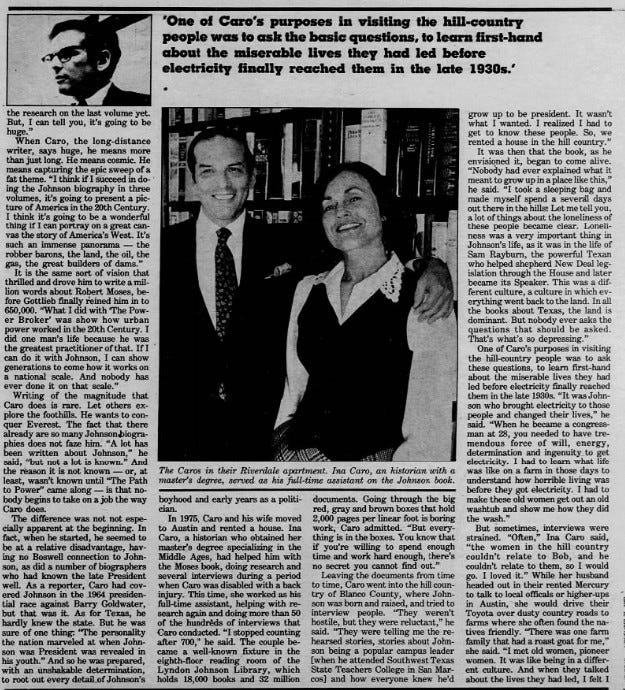
He and his wife/researcher Ina held onto their New York home while renting a place in Austin, where they lived "[on and off]” for three years, and scattered comments suggest that they rented various places in the Hill Country, where interview subjects “weren’t hostile,” Caro said, “but they were reluctant” to tell the story of Johnson City’s most celebrated son with yet another pair of New Yorkers. “What bothered them before was that ever since Johnson was president, reporters and writers would come for a week and leave and say they understood the Hill Country. Well, let me tell you, the Hill Country is a damned hard place to understand.” Especially, they might have guessed, for an outsider like Caro, dressed in what everyone describes as his “Ivy League appearance,” the horn-rimmed glasses and slacks, the yapping sheepdog and beautiful wife with the same cerebral vibe.
So that’s why they needed to live in the Hill Country: they had to understand the soil, the climate, the culture.
The reason they needed the place in Austin is because that’s where the Lyndon Johnson Library is, the locus of his research.
One thing that made the Johnson biography so much more taxing, physically, than his book about Robert Moses is that, in New York, he could dart around conducting two or three different interviews a day; in Texas, however, “Every interview seemed three hundred miles from the others. Over and over.”
Not to mention he was contending with old memories, events that might’ve been foggy before the interview subject considered the blasphemy of denigrating a president (a crime adjacent to blasphemy, for a certain generation).
I’ve mentioned, in this series, the story Caro often tells about tracking down one of Lyndon’s oldest friends, Vernon Whiteside, who had the information to break open the whole story of Johnson's formative years but was, by all accounts, dead—until Caro tracked him down to a trailer park in Florida.
But there are two versions of that story.
In his 2019 memoir, Working, Caro claims that, when he found Whiteside’s whereabouts,
I didn’t ask the [mobile home] court’s operator to bring him to the phone. It’s too easy to say no over the phone and I wasn’t going to give him the chance to say he didn’t want to talk to me[.]
So he boards the soonest flight to the nearest airport, rents a car, drives out to the trailer where Whiteside lives with his wife and gets his interview.
Cracks his story.
But he tells it differently in a Newsday profile from 1982. There, he claims that he did try to speak with Whiteside over the phone, but the woman who answered it wouldn’t allow it, and that’s when he boarded the plane.
Another detail—not explicitly changed from the version presented in Working, but it adds to my point—he didn’t just sit down and collect his facts from Whiteside and go home. Their interview unspooled over three “long afternoons”.
This series is informed so far by roughly 300 articles and 100+ audiovisual interviews. They span roughly 45 years. Caro tells the same stories across those decades. They are almost identical in their rendition, not only the details but the wording, the intonation.
This is the one inconsistency I’ve found in any of his work stories. I’m not sure what to make of it, but nor does it seem irrelevant.
Consider the maneuvering entailed in that story: the ride to the airport, the airfare itself, the rental car, the cost of three days’ lodging.
That excursion to meet Whiteside probably cost several hundred dollars, in the 1970s.
And it was worth it! He got his story.
But such costs would go up with the decades, and Caro would still be chasing leads.
How many times did Caro jump from his desk, chase a promising lead at great expense, driving or flying some drastic length, and the person wouldn’t speak to him, or the document wasn’t there?
Surely, in the 50 years he’s been working on this series, it’s happened once or twice.
How is that accounted for?
Another stream of income, bolstered by the quick success of Path to Power, is Caro’s speaking fee. Lectures around town about Robert Moses (“Can There Be Another?”), about Lyndon Johnson, various aspects of political power.
A reporter named Woodie Fritchette attended one, in the late ‘70s, and wrote it up. A glimpse at Caro in the thick of his work on Volume One. A guy who stands already, at 40, “high in the ranks of America’s latest folk hero, the investigative reporter,” this being, incidentally, the same set of years in which Bob Woodward and Carl Bernstein were making their fortunes reporting the Watergate scandal. But as Woodie Fritchette reports, from Caro's ‘77 speech at Troy’s Russell Sage College, the reason he left Newsday is he got frustrated with “go-with-what-you’ve-got journalism,” the deadline limitations that forced him to write around what he didn’t know, rather than paint the whole picture.
Caro, whose modesty borders on shyness, is not from the turned-up collar, cigaret-smoking [sic] school of journalism. He is not flashy. He leaves sensation to others. “It’s enough to tell the truth,” he tells his listeners. He appreciates the effect of understatement, and nearly destroys the mystique of the investigative reporter when he says that the tools of the trade are a taste for hard and unglamorous work, patience and attention to detail and accuracy. He adds disarmingly that some of his own best efforts were the result of “dumb luck” as much as anything else.
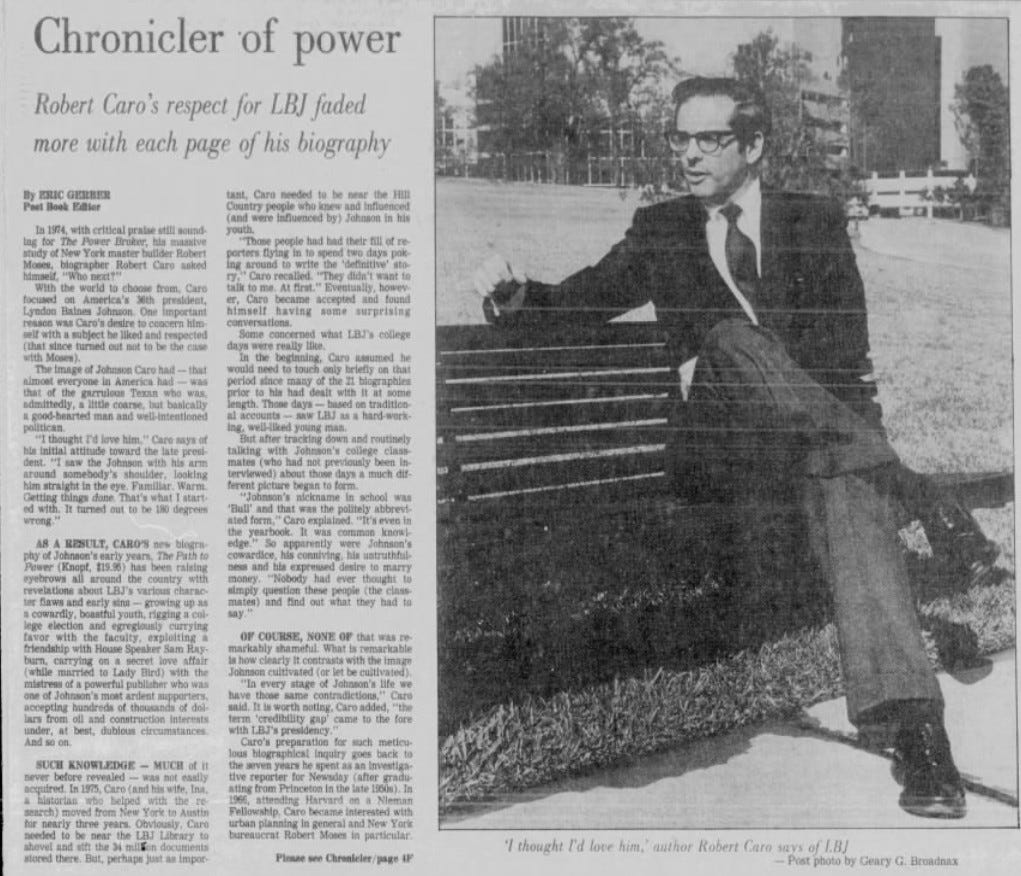
In response to the biography’s excerpts, which had run in The Atlantic a few months prior, Caro and the magazine’s editor, William Whitworth, were charged by some with occupying an ethical gray area by not citing Caro’s facts as rigorously, throughout the prose, as a reporter might have done. Defenders of Johnson latched onto this and said Caro’s assertions were based on nothing, or he was jumping to conclusions.
“I kept waiting for someone to come to me and tell me to my face and tell me something in the book that wasn’t true,” he told the Dallas Times Herald in ‘84. “But nobody came forward, and I was getting quite angry about the attacks.”
Now that the book was out, anyone questioning the integrity of Caro’s reporting could consult with the 200-volume bibliography that starts with a note to the reader:
A bibliography for this book would be another book in itself, and an exercise in pedantry to boot. The following list includes only those books specifically cited in the notes, and I include it for one purpose alone: so that I can use abbreviations in the Notes.
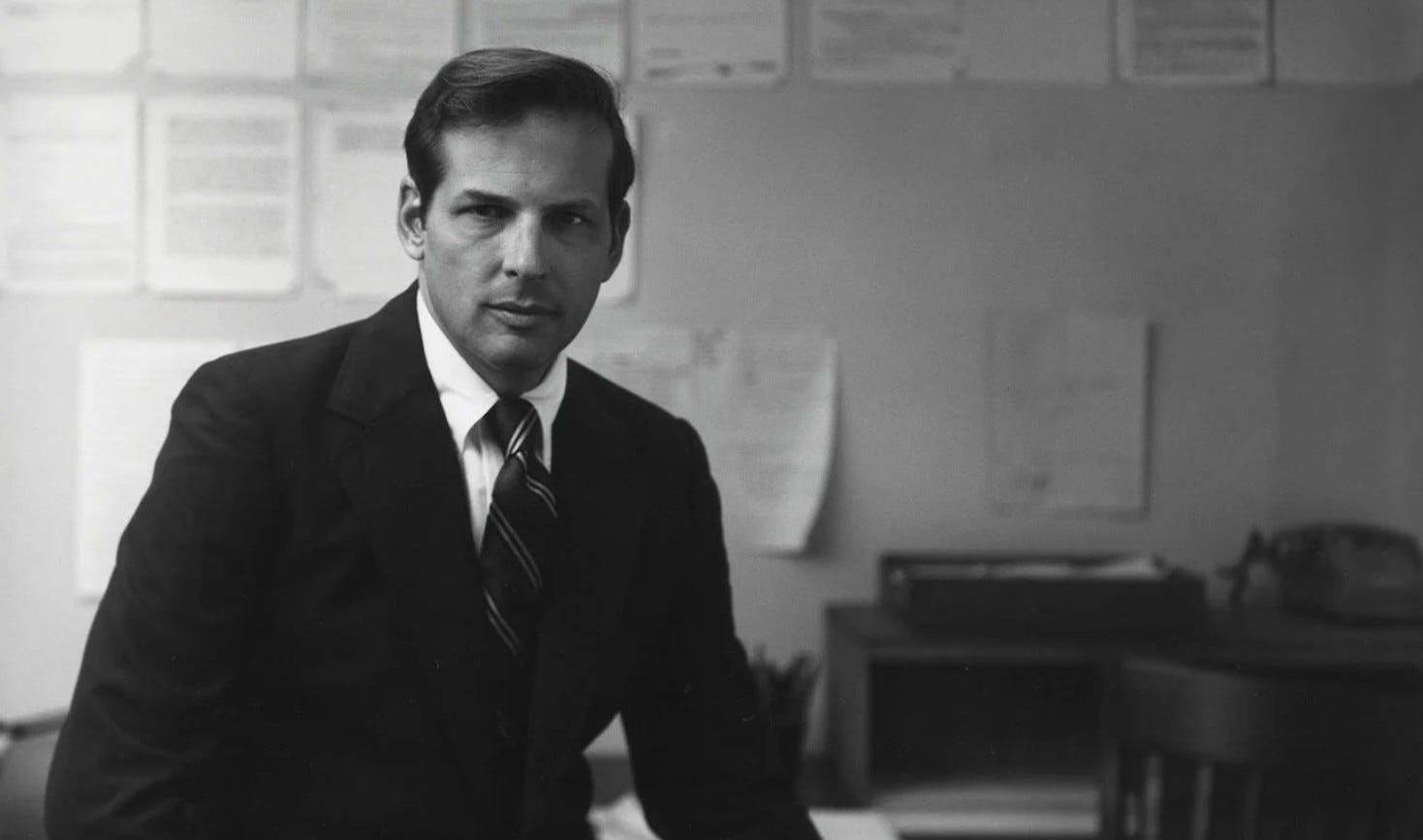
The gist of his research is conveyed in the observations of reporters who visit his Manhattan office for interviews, always marveling at the “spartan” and “orderly” lack of decor. His writing desk situated under a wall-length corkboard and, on the opposite wall, a bookshelf with pertinent titles about FDR, the New Deal, Texas geology and topography. You’d think a monk works here but reporters are impressed as much by the office as by the man who occupies it, whose outfit is neat and preppy but always plain, a dark blazer with slacks and a “regimental” tie, i.e., the striped ones, with four colors, running upper-left to lower-right.
“Caro,” says a reporter for the Houston Post, “turns out to be an affable, almost chatty person,” but just as he writes of Lyndon Johnson that the man’s life ran along two beams, “a dark side and a light side,” interviewers note the quick shifts in Caro’s own demeanor, his “intensity” and “enthusiasm,” saying that it’s largely characterized by the way he tends to “speak softly” (LA Times) but “with growing intensity,” his “jovial impatience” or “boyish congeniality” (Newsday), or the above-mentioned “humility that borders on shyness.”
“Controlled in his manner, he sometimes finds release in sudden laughter accompanied by a happy, assenting nodding of his head.”
But there’s fairly regular mention, in the coverage of these first two volumes, of “the flash of anger,” steely and quiet, when confronted by coverage that he considers (and the word is repeated through the years) “unfair.”
“The criticism wasn’t fair,” he tells that Newsday reporter, addressing fiery reactions to excerpts printed in the Atlantic. “There’s a book out now, and anyone who reads the book will find it all substantiated.”
Johnson insiders were able to argue, in response to the four excerpts that ran in the Atlantic, that Caro was propelled through seven years of research and travel and writing and rewriting and quarreling with his editor purely because, as the 36th president’s advisor and speechwriter Jack Valenti said, he has “an extraordinary capacity for a vendetta seemingly without origin, unless Princeton offered Caro a special course in the Spanish Inquisition, and he mistook Torquemada for a hill country congressman.”
Polonius who? “I have read a good many hatchet jobs,” Valenti continues, but when it comes to character assassination Robert Caro is “the literary equivalent of Charles Manson.”
Not to mention the divide that Caro himself would attest: he is, as Johnson’s aunt would call him, “a city boy,” possessed of the unshakeable Ivy League poise and braininess that earned sneers at Newsday (colleagues would claim to remember, 35 years later, Caro coming to work in bespoke suits that the biographer claims he could not possibly have afforded; they remember that he kept to himself, with an air of superiority, and never joined them at the local watering hole, Lou’s, even though, according to Caro, he was in fact standing right there).
But now that the book was released, and everyone could see how presumably unhinged this elite city boy really was, they cracked the book to find that, beyond a slim introduction, Lyndon Johnson himself does not appear for nearly 100 pages.
In a Washington Post profile, Curt Suplee peppers readers with the highs and lows of critics’ responses, from “repetetive and fiercely polemical” (New York Times) to “a monumental political saga” (also the Times), and funnels the whirlwind back to
The object of this monsoon of controversy, munching placidly on a room-service sandwich at the Mayflower, seems an unlikely target. At 47, Caro…has the mild voice and pedantic poise of a grad-school lifer. After carefully replacing his glasses (removed for photos), he settles into a chair, brings his fingertips together and, with his forefingers, begins obsessively kneading the balls of his thumbs.
The criticisms, he says in his quiet New York consonants, “are not fair. In fact, they’re not true—they’re lies. The documentation is so thorough and complete that no real questions [of their veracity] can exist in the mind of a truthful person.”
Yeah it gets into some gossipy elements, like Johnson’s affair with the tall and beautiful Alice Glass. “It takes up fifteen pages in a 900-page book,” he told the Houston Post, “but that’s what everybody jumped on immediately.”
Not to mention that the number of people who read an 800-page biography, and see the truth for themselves, will never come close to the number that skims this 500-word rebuke over their coffee, calling him the Charlie Manson of literature.
It wasn’t fair.
He had no power to stop it.
Others, taking issue with the book, seem to find the artistry of Caro’s prose and the rigor of his reporting hard to refute, and there’s hardly a review that doesn’t bow to it; if, however, the reporter’s not keen on where Caro takes it, the praise is voiced with reticence, suspicion, like the good prose and thorough research comprise a Trojan horse for the types of “vicious canards” Robert Moses once accused.
Another reviewer, Kemper Diehl, goes into the weeds on Caro being a great prose stylist but ultimately, when it comes to his topic, an outsider.
“Caro provides a number of interpretations…that simply miss the mark…Politics in Bexar County in the 1930s divided along reform vs. machine lines, not so much on the liberal-conservative lines that obsess Caro.”
Dr. Betty Sue Flowers, Director of the Lyndon Johnson Library (2002—2009), elaborated on that point in a Zoom call this month.
A fan of the series, and a native of Texas, Flowers emphasizes that Caro’s “description of the Hill Country in the 30s was absolutely brilliant,” but disagrees with his suggestion that Lyndon Johnson was propelled (at least in part) by “a chip on the shoulder because of poverty.
“That was not the case in the south. I find up here in the north that, because it’s more diverse, it is wealth that divides the classes. Growing up in the south, it is not money” that divides the classes, but lineage, “the stock that you come from.” In that respect, she says, “It’s like the old aristocracy,” and Johnson, far from seeing himself through the lens of poverty, would have seen himself as a descendant of “leaders” (both his father and grandfather were popular regional politicians).
The Library’s previous director, Harry Middleton, had been a speechwriter for Johnson, and wrote in the Library’s newsletter that Caro’s Path to Power is motivated by “a loathing so deep it coats a steamy sheen over his prose.”
Middleton later acknowledged it was poor taste, putting those remarks in a public newsletter, but he didn’t apologize. Didn’t change his view.
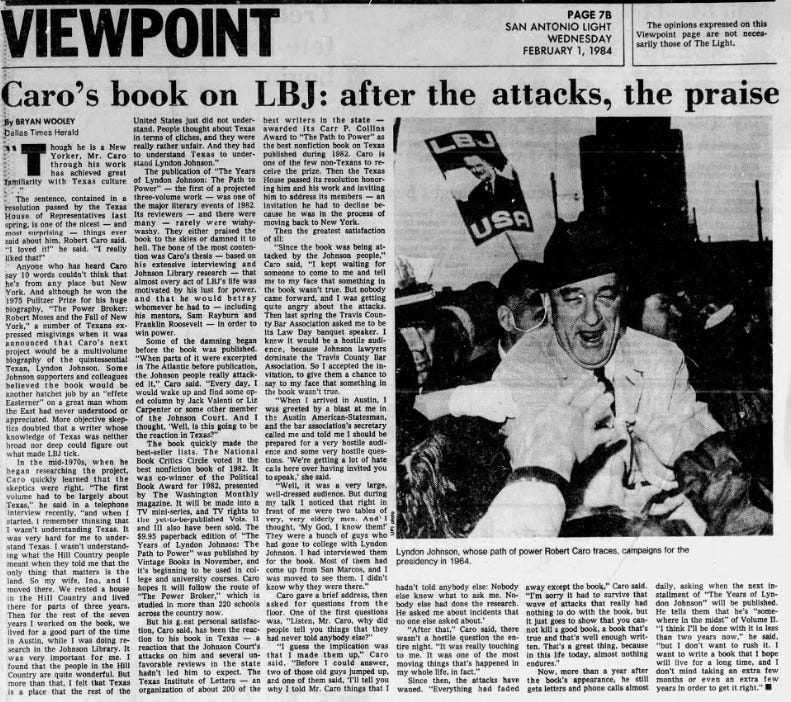
The closest he might have come to doing so was in 1984. A reporter was writing about the long tail of Caro’s book (occasioned, it seems, by the release of a $9.95 paperback from Vintage). The reporter spoke with Caro about the controversy over the excerpts printed in The Atlantic, which alleged that Lyndon Johnson, in both the Senate and vice presidency, had accepted donations by way of cash-filled envelopes, delivered by hand. As he told the Dallas Times Herald, “Every day I would wake up and find some op-ed column by Jack Valenti or Liz Carpenter [Lady Bird’s press secretary], or some other member of the Johnson Court. And I thought, ‘Well is this going to be the reaction in Texas?’”
But then the book came out and the response was largely positive. It sold almost a half-million copies. It won the Carr P. Collins award, from the Texas Institute of Letters, for best nonfiction—a prize seldom given to non-Texans.
Such was the power of his prose.
Brian Lamb, of C-SPAN’s Booknotes, asked Caro in 1990:
“How do you afford to do this kinda thing?”
Caro’s response:
“When I look back on The Power Broker, for the first five years or so [before switching publishers] it was just a struggle, from month to month, to keep going. That [book] was not a bestseller at first. But it almost immediately began to be used by really hundreds of colleges, y’know. Different courses. And y’know I won the Pulitzer Prize and other prizes. I was able to get a much better contract for [a biography about] Lyndon Johnson. The first volume of the Johnson [books], of course, was [Caro squirms a bit, laughs, shifts in his seat] a major bestseller or whatever and all the money problems have ceased [cue the restless punctuation Caro often does—shrugging one shoulder, and cocking his head toward it—to signify that he’s reached the decisive end of an awkward topic] and it’s not even a consideration anymore.”
On top of the praise and financial security, the people Caro needed to interview were now, at last, coming to him.
