Lambs in College
On John Pistelli's "Major Arcana"

1.
I finally read John Pistelli’s novel Major Arcana. It was my last book of 2025 and like other holiday engagements it was fraught with argument and the argument stemmed more from personal insecurity than actual grievance.
That’s because Major Arcana is a campus novel (kinda) and Pistelli is a scholar. He writes about the classics in his newsletter. He gives lectures about them.
My own reading is not that sophisticated. I have not read Pride & Prejudice. I don’t even know which one is the whale.
But this is not a gated book (as I feared). It’s about reading, I think, and about parentage and ageing and friendship.
Here’s a quote from Cormac McCarthy’s last novel:
“[H]aving read even a few dozen books in common is a force more binding than blood.”
I think it’s also about that.
2.
I argued a lot with Major Arcana but not in a bad way. There were passages in which the characters are expounding, at length, with brilliant thought-provoking ideas and I would peck a note into my kindle, “Too explicit,” because I’ve long believed that you cannot write a gripping or propulsive or real-seeming novel if you’ve got a cast of perfectly erudite characters who can articulate their thoughts in quick, reliable, effortless paragraphs.
I found myself sitting with Major Arcana for hours at a time, engrossed, moved, even kinda turned on once or twice — and then, every 40ish pages, “Nope,” highlighting something and annotating, “not how it’s done, Pistelli…”
Eventually I’d look up from my Kindle and see the sun was in the wrong corner of sky and, impatient, set the book down for the day, to see about dinner: greens and rice and rotisserie chicken.
A healthy rounded meal; every single thing from a bag.
3.
There’s a great thread running through Silence of the Lambs, by Thomas Harris, that I only discovered while reading it a third time last year.
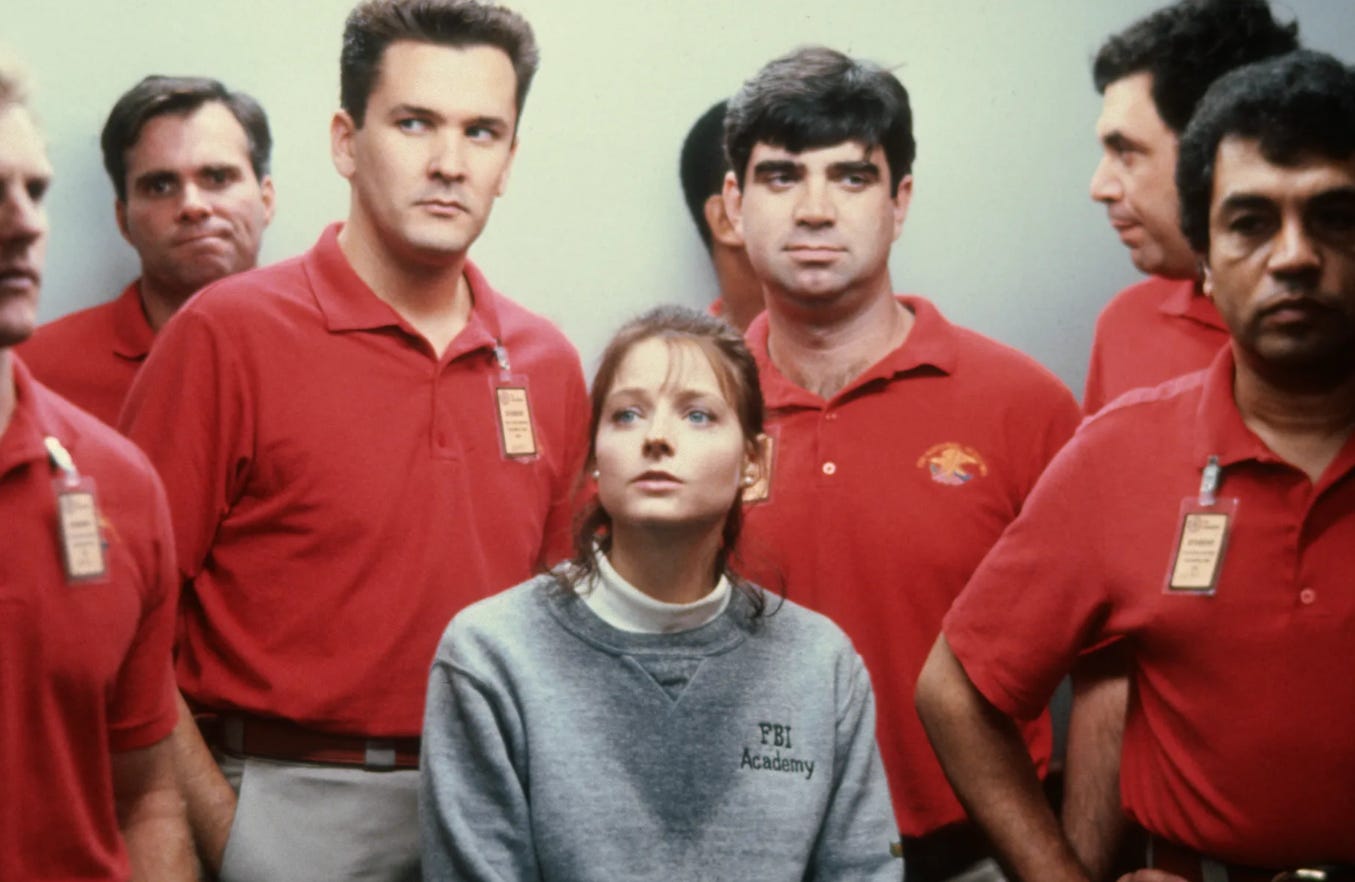
The protagonist, Clarice Starling, is a young FBI recruit. She falls under the tutelage of FBI Director Jack Crawford. Crawford was partly responsible for capturing the cannibalistic serial killer (and former psychiatrist) Hannibal Lecter.
Together, Crawford and Starling are trying to catch a new serial killer and Crawford says they need Lecter’s insights.
Starling is flattered that he wants to send her to speak with Lecter. Her father was a cop, killed in the line of duty, and she sees in Crawford all the intelligence and honorability of her father.
So Starling goes to the mental hospital and, while she’s talking with Lecter, we see how, despite his horrific crimes, he’s actually quite refined and brilliant and clever.
Seductive even.
Jack Crawford’s initials are JC. Jesus Christ.
Hannibal Lecter’s initials are HL. Hell.
4.
One of the book’s protagonists, Ashley del Greco, is an extremely brilliant teenager for much of the book. I think impossibly brilliant but that’s OK in fiction.
Pistelli makes her phenomenally erudite so that, when she does something ruinously naive or impulsive, it makes a more poignant point about the haplessness of youth.
Give em all the words you want — doesn’t make em wise.
5.
What Clarice Starling doesn’t seem to understand until maybe the end of Silence of the Lambs is that the qualities she comes to admire in Hannibal Lecter are the same ones she admires in Jack Crawford, her boss (also Lecter’s nemesis).
Not only that: Crawford and Lecter are sending Starling back and forth as a pawn by which they torment one another.
This is, in its cruelty, very much something that a person of Hannibal Lecter’s status would do; it is not, however, something that someone of Jack Crawford’s status would do.
And so which of these two role models, in that respect, is more sincere?
6.
When J.K. Rowling finished the Harry Potter series and then wrote her first “adult” novel, The Casual Vacancy, she went on the Charlie Rose show where he asked her why she’d written another novel with a teenager at the center.
Rowling said that teenagers don’t have much going on in their lives (bills, work, errands, etc.). That’s why the can sit around and philosophize and worry about ideas, friendship, meaning, love; she wanted to explore those ideas in her novel and a teenager seemed the only practical avatar for doing so.
What she doesn’t mention is the trade-off, which is that your protagonist has to also be kinda stupid.
But then, when you’re dealing with a young person who’s never experienced anything, where’s the line between stupidity, naivete, and inexperience? Are they all shades of the same thing?
If you could take a ten-year-old child, and instantly upload a library’s worth of knowledge into that child’s brain, would they somehow cease to be a child? If only in the abstract sense that you’d have “ended their childhood,” or “ruined it,” by opening their eyes to whichever branches of reason and heartbreak and broken hope by which we measure maturity?
The place where Major Arcana shows its heart is that I think, if you were to ask it that question with a Oija board or something, it’d say no. That youth is about learning things, warehousing knowledge, and then maturity’s about being shown, through experience, that you somehow don’t know anything.
7.
That business between Hannibal Lecter and Jack Crawford: it’s their pettiness that reveals them.
Starling will share, with Lecter, Crawford’s theories about the case — and Lecter pounces; he betrays all attempts to be coy, and to ransom his insights in exchange for privileges, because he’s got this weak spot, his vanity, and he cannot stay composed when she praises his captor.
Later, while speaking with her boss, Starling will say something about Lecter’s intelligence – and Crawford, in turn, will lose some of his characteristic composure. He’ll explain that Lecter is a con-man, that his insight into Buffalo Bill doesn’t have anything to do with intelligence, that they’re just the same kind of monster.
Crawford humiliated Lecter by capturing him; at the end of the novel, Lecter humiliates Crawford by escaping.
And what’s the first thing he does, once he’s out and settled with a new identity, in another country?
He calls Clarice.
She can’t call him back.
It’s a power move.
8.
Here are words from Major Arcana that I had to look up.
Au gratin. Rentier. Tulle. Tarsus. Gelid. Tarn. Impasto. Peignoir. Indite. Puce. Pathic. Haruspex. Cartomancy. Prolix. Lemniscate. Cupidon. Contrapposto. Invigilated. Peregrinating. Coeur. Perseveration. Emesis. Gnosis. Studium. Transmasc enby. Trochee. Sarong. Gesamtkunstwerk. Tessellating. Scyphozoan. Diaphanous. Syncretic. Gematria. Reprofuturist (“no definition found”). Enscorcelled. Binaurally. Juridically. Fungating.
I knew the other ones.
9.
FBI Director Jack Crawford’s chivalric avuncular goodness, in the novel, is incredibly compelling. He’s like Atticus Finch. His goodness is as compelling as Hannibal Lecter’s sinister mystique. They are genius foils.
All the more impressive that their author never succumbs to the charms of either. The story is Starling’s. She is less interesting but more compelling. As Harris closes a chapter, early on, in which she does a very wrong thing with the best of intentions:
“Starling was young.”
I loved this book in the most complicated way.
Thanks for reading Big Reader Bad Grades! My novel Cubafruit just got nominated for the 2025 Samuel Richardson Prize! If you like what you’ve read here, I think you’ll like the book as well — you can grab a $5 copy here:
The movie and the book are electric when HL is in the scene. I felt the same way about Goring when watching the movie Nuremberg. We're not supposed to be attracted to human monsters but we are.
It's funny -- my favorite part of Cubafruit was the very end, when we finally actually meet Themus and he goes into his speech about how he views the world. I thought it tied the whole book together so well.