Three Pivotal Moments When Someone Told James Ellroy to Chill Out and He Listened
And how his new novel RED SHEET *happens* to be his best in 25 years.

1.
When James Ellroy submitted his novel LA Confidential to Nat Sobel, his agent, it was 800 pages long.
Sobel called an editor at Warner Books, Nancy Nieman, and told her Ellroy’s manuscript was ready and that it was 800 pages.
Nieman said absolutely fucking not. No. Reduce that by a quarter.
Ellroy was in his early 40s. He’d had a big success with The Black Dahlia (1987), the first volume in a quartet, and then the second one did well and they had high hopes for this third one—nobody was questioning his abilities.
If you want to sell books and make a living, if you want other serious people to take financial risks on your work, then look at the numbers and act accordingly.
2.
Stephen Powell’s 2023 biography of Ellroy, Love Me Fierce in Danger, recounts how Nat Sobel came up with a solution:
I had the manuscript on the desk in front of me, and as a joke I said to James, “Well, maybe we could cut out a few small words.” I meant it entirely as a joke. But I [went through a page and] cut out about a dozen words… James said, “Give me that.” […]When he was done with the page, it looked like a redacted piece from the CIA…It was terrific…He took the whole manuscript back and cut hundreds of pages from the book [that way]…
Nancy Nieman’s refusal, he said, “forced” Ellroy into cultivating the distinctive prose style.
“It came from her, sight unseen, saying, ‘Cut 25 percent of the book.’”
3.
LA Confidential comes out, critics rave, but it comes from a smallish imprint, Mystery Books, and critics are divided somewhat on the slightly “telegraphy” prose style.
Jack walked up and kicked the door in. The arclight snapped on, a living room caught flush: Christmas tree, two kids necking in their undies. Jack shouted “Police!”; the love-birds froze; light on a fat bag of weed on the couch. The girl started bawling; the boy reached for his trousers. Jack put a foot on his chest. “The hands, slow.” The boy pressed his wrists together; Jack cuffed him one-handed.
Ellroy knows he’s onto something.
4.
So does Sonny Mehta, editor-in-chief at Knopf, born in New Delhi and raised in Cambridge, a fairly-recent transplant to New York from the world of UK publishing. He was well-known and widely respected in publishing by the time his name exploded into the press, in 1990, for purchasing Bret Easton Ellis’s controversial American Psycho within 48 hours of Simon & Schuster cancelling the book.
Mehta invites Ellroy to lunch at the Four Seasons. Mehta chainsmoked over several glasses of wine and ended with scotch. Ellroy was maybe a dozen years sober. Mehta stayed quiet, with a “fixed stare,” as Ellroy, nervous, started talking faster.
A pivotal moment came halfway through the meeting. Ellroy had wolfed down his meal whereas Mehta’s hamburger patty sat untouched on his plate. By now, Ellroy had developed his own fixed stare on the hamburger which was distracting him from conversation.
“James,” Mehta said. “Do you want to eat that hamburger patty?”
“Yes,” Ellroy replied, taking the hamburger off Mehta’s plate
So began their partnership.
5.
Mehta buys his already-completed novel White Jazz off of his publisher at Warner Books. It’ll be Ellroy’s debut under Knopf’s imprint.
Except he’s got issues with it. Invites Ellroy to his apartment and says, I think you leaned too hard into the telegraphing style. He demonstrated a few small insertions to the prose that made it easier to read.
Ellroy, without any apparent protest or distress, went home and made the changes.
As Powell puts it, “He spent twenty days reworking the manuscript at a rate of forty pages a day.” An old friend, from the library he used to visit, describes Ellroy’s working method from his early career:
He would take one bottle of instant coffee and he would pour it into a cup and then he would take it to the sink, and I never would have believed this unless I had seen it myself, he would pour hot water straight from the faucet into the cup, stir it up, drink it down and then he would sit and write for hours.
6.
White Jazz comes out, September ‘92, and Powell describes how it’s “a minor commercial disappointment” for Knopf. Reviews were strong, but discouraged readers with remarks about the difficulty of the prose. Plus he contends that it was vying for public attention at the peak of a presidential election season.
Ellroy’s in his 40s now, he’s onboard with a venerated publishing house, and they just took a risk on his first book under their imprint—and it underperformed.
He’s just finished a years-long project with the LA Quartet. He wants to try something new. Something BIG.
He moves into the way more chaotic and colorful ‘60s with a new trilogy. Calls it Underworld USA. The first installment, American Tabloid, is a sprawling story that, as he first dreams it up, will involve a nexus of crime surrounding John F. Kennedy and Robert Kennedy, then culminate in the murder of Marilyn Monroe, disguised as suicide.
He writes a big outline and submits it to Sonny Mehta.
Mehta calls him in for a meeting. Lays it on him gently: This doesn’t work. Points out the similarity to a recent Michael Korda novel about Marilyn Monroe.
Mehta tells him, Go home, re-work this.
Ellroy goes home. He re-works it.
The book is a smash. A bestseller. Time magazine’s best book of 1995.
7.
He follows it with The Cold Six Thousand which is way more divisive and controversial because he’s taken the clipped and beyond-minimalist prose style of LA Confidential, put it on a spoon, and held it over a lighter.
A TV sat on a table. A barman goosed the sound. Moore shoved up to a phone booth. Wayne scoped the TV out. […]
The picture jumped and settled in. Sound static and confusion. Cops. A thin punk. Words: "Oswald"/"weapon"/"Red sympath-"
A guy waved a rifle. Newsmen pressed in. A camera panned.
Check out Goodreads and you’ll see a lot of people just trash it, fuck this, unreadable—and I felt the same way in the first five pages but it culminates into something amazing. His most complex and gutting novel yet.
8.
The trilogy’s third novel, Blood’s a Rover comes out in 2009. Mehta thinks it’s Ellroy’s best novel yet. Critics are less convinced. The protagonists of those first two volumes are dead or retired and it feels only loosely connected. The book is inventive, propulsive, funny and shocking—it’s more technically impressive than its predecessors.
But it feels less like art than craft. Ron Howard. Like he’s gone from making weird, huge, baroque grandfather clocks to fancier, sleeker, high-tech wristwatches.
It feels like he got bored.
When it was over, Ellroy decided he wanted to write a memoir about his sex life.
Sonny Mehta, editor-in-chief, suggested this wasn’t a great idea.
Ellroy did it anyway.
The Hilliker Curse (2010) is named after his mother Joan Hilliker, whose promiscuity, abusiveness, and 1958 murder Ellroy considers the catalyst for his lifelong obsession with sex, women, and crime.
The memoir was lurid and over-indulged in alliteration. What he calls “scandal rag” or “tabloid” language.
Reviews were overwhelmingly negative. The book sold poorly. His editor’s tempering advice had been right. The book embarrassed him.
As Ellroy would later concede about the book, “I’ll be happy to see it go out of print.”
9.
So what’s next?
He’s in his early 60s, operating at the height of his powers (and if you don’t believe that Ellroy is operating at the height of his powers—just ask him).
He’s got clout and know-how, he can get away with things, he needs to do something BIG, something NEW…
He decides to do a second LA Quartet. Except this one will be a prequel. Set in the 1940s, eve of Pearl Harbor, then it’ll run through the whole war.
A proper follow-up, a proper challenge.
The first volume is called Perfidia. It comes out in 2014.
It is 720 pages long.
Just 80 pages shy of the length that Nancy Nieman told him, fifteen years prior, had warned him against.
“I had my eyes set on a 700 page hardback,” Ellroy told The Quietus, “and I got there.”
10.
It’s followed by Volume 2, This Storm (2019), which is nearly as long as Volume 1, just as heavily populated, just as busy and globetrotting...
But this is where the seams begin to show.
Consider this moment where the series villain, LAPD sergeant Dudley Smith, searches the house of murder victims:
He emptied cupboards. He opened canned foodstuffs and dumped the contents. He dumped drawers and examined innocuous glut…He ripped apart stuffed furniture. He unscrewed light fixtures…The walls now. He brought a stethoscope. He attached the earpieces and began downstairs…He tapped the walls and listened. He got all solid thunks.
Dudley’s efforts are rewarded. Here’s what he finds in a hidden compartment:
A swastika flag, a rising-sun flag, a hammer-and-sickle banner. Flags for Franco’s Falange. Ku Klux Klan flags. Redshirt Battalion flags. Flags ablaze with “SQ”s and coiled snakes.
It happens on page 111 of the trade paperback of This Storm.
And it resembles THIS scene from page 115 of Perfidia, in which Dudley’s colleague, LAPD’s forensic expert Hideo Ashida, is re-searching the house of a murdered family for evidence.
He stood in the hallway. He heard Dudley’s boys bullshitting outside. His eyes traveled. He saw dust motes and a bug on the wall….Anomaly. Inconsistency. Red-alert Flaw. Note the ceiling-wood strips, laid in lengthwise…The seams disrupt the wood-grain flow…They form a two-foot square…He hit the middle of the square. The square flew back, off an inside hinge…A room. Less than an attic. More than a crawlspace.
Hideo’s efforts are rewarded. Here’s what he finds:
a shortwave radio and ledger…He turned on the radio…The dial numbers made no sense…A man shrieked in Japanese. He defamed the United States…It was rabid-dog propaganda.
A family is murdered. The cops are flummoxed. One of them returns solo. It’s dark. They toss the place. They press at the walls. They find a secret stash of SUBVERSIVE MATERIAL.
Halfway through This Storm, the second volume of James Ellroy’s second LA Quartet, a question comes to mind:
“Are they going to let him do this four times?”
11.
Ellroy announced, in 2023, that the Second LA Quartet was CANCELLED.
Or not really “cancelled,” per se.
“The Enchanters came in so strong,” he told Michael Connelly on-stage at an LA Times event, “[my publisher] Alfred A. Knopf, my editor…and agent, were so high on it…that I ditched my idea for the second LA Quartet after two volumes…and turned it into a quintet.”
The quartet was aborted in favor of a new trilogy; but the trilogy and the half-finished quartet come together as a quintet, which is a prequel to the ORIGINAL Quartet, which is followed by the Underworld USA trilogy…
12.
The Enchanters comes out in 2023 and it’s the proper launch of the new trilogy. Its narrator is a lewd dude named Freddy Otash. He’s a legbreaker and gossip hawk for tabloids. Disgraced former LAPD officer and private detective.
It’s a chunky ambitious sprawling complicated murder mystery surrounding the death of Marilyn Monroe. 448 pages.
It starts with Freddy Otash learning Marilyn Monroe is dead and being asked, by an old friend on the force, to go in and get forensic details on the scene before anyone goes in and mucks about.
“She was dead,” Freddy tells us when he gets there. “I felt her and smelled her all over me.”
He searches her bedroom by flashlight. He breaks open a drawer. Here’s what he finds:
Fuckee-suckee pix. Four in all. Black-and-white Polaroids. The nude Marilyn Monroe and a cruel stud with a big pompadour. There’s whiteout strips over his eyes…They’re fucking, sucking, going 69…Dried jizz crusts. Some perf spritzed all four pix.
When the book was released, there was a consensus on the subreddit, summed up well-enough by a recent comment: once you hit page 140 the thing really FLIES.
13.
I thought The Enchanters was boring, but better than the last two novels. There was hope.
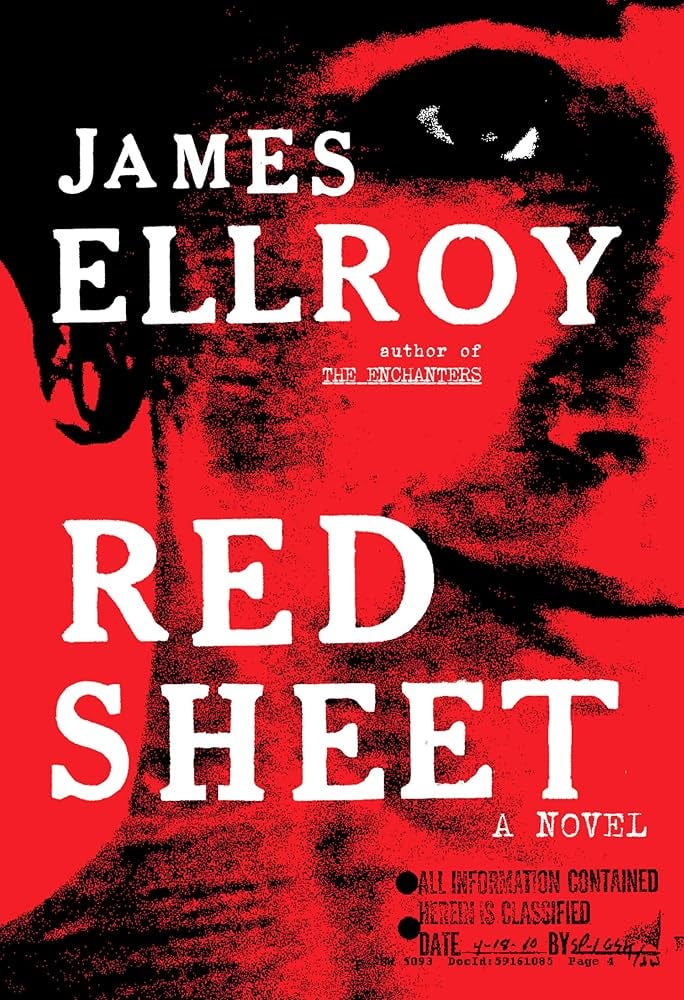
Knopf was kind enough to send me a review copy for Red Sheet. The first page blurbs a review of his previous novel that appeared in The New Yorker:
James Ellroy, the neo-noir eminence of L.A. crime fiction, is back, with his favorite snake, Fred Otash, in tow…And he sure can shoulder a novel.
It does not quote from the latter part of that same review:
It’s perplexing to see Ellroy let his story go so slack, to see the tension flatlining, resistant even to the defibrillations of jokey, jittery tabloid-speak.
14.
Red Sheet is quicker, right away, and busier and more enjoyable and atmospheric than Enchanters.
But then Ellroy catapults us into a brick wall of exposition, about 20 pages deep, talking about what a “red sheet” is (something about the files kept by law enforcement and intel services to keep tabs on suspected communists).
I gave up. Quit reading.
Then I started seeing reviews. They were glowing. So I tried again. Picked up where I left off and by the end of a twenty-minute sitting I was hooked again because Ellroy’s finally writing Richard Nixon and it’s wonderful. He wrote Nixon’s voice once before, in Blood’s a Rover, but we only get transcripts of his phonecalls with an enforcer named Dwight Holly:
RMN: You’re not taping this, are you, Dwight?
DH: No, Sir. Are you?
RMN: Yes, I am.
Nixon, in that book, is losing it, pre-Watergate. Can’t stay on topic. Tries to talk like the kids. Confiding to his enforcer that he enjoys their conversations.
DH: Sir, I enjoy our chats very much.
RMN: That Irish cocksucker Jack Kennedy stole the 1960 election from me.
DH: Yes, Sir.
RMN: The cocksucker is dead and I’m the president of the United States.
DH: Yes, Sir.
RMN: Keep tabs on you-know-who for me.
But that Nixon is a pure caricature. Comic relief.
In Red Sheet we see Otash tailing a Nixon who’s a bit more textured, broken. He’s lost his presidential bid against John F. Kennedy, he’s working at a law firm, and tonight (Halloween) he’s headed to a bar, having a couple drinks, engaging polite small talk with regulars, and then getting up. Places to be! But hey where’s he headed?
[Nixon] turned east on Packard. This was mixed-race turf. The restricted-covenant line blurred at Pico. We passed a run of bungalow pads with RE-ELECT BROWN signs staked on the lawns. Nixon eyeballed them and made some sort of hex sign.
Another bar, that’s where. And he sits alone. Sips two drinks. Hunts for small talk.
Ellroy has discovered the way to make Richard Nixon sympathetic: from a distance.
15.
Late at night, Otash breaks into the office of Nixon’s psychiatrist, Douglas Kallman. Tosses the place, in the dark, with a flashlight and assorted tools. “I packed my deep-dial microscope to surmount document-study contingencies.” He finds Kallman’s notes about Nixon’s therapy sessions and here’s what they say:
“BRUTALLY BITTER LONELINESS.”
“WALKABOUTS.”
“FRIENDSHIP HOTEL SUITE AND FRIENDSHIP PHONE.”
“ENJOYS GIVING MONEY AWAY.”
“BEREFT OVER THE DEATH OF WHITTAKER CHAMBERS, LAST YEAR.”
“LONELY”
“LONELY”
“LONELY”
Ellroy pulls it off. Makes Nixon more pathetic than contemptible. The ending might be intended to subvert that feeling but I can’t be sure because I was once again confused as I presume to be the point by now.
Guess what else Freddy finds in Kallman’s office, searching it in the dark with a penlight:
A fat stack of smut mags: Rogue, Gent, Swank, Knave, For Studs Only, Beaveroo, Beaverama, For Bushmen Only, Volumes I, II, III, IV, V, VI. Three illustrated eugenics textbooks. In German and unreadable. Nazi-era vintage.
Sounds familiar but here I am, smirking.
16.
Nearly 100 pages deep we see Freddy Otash stumble upon a murder scene. It’s a private residence, 5 a.m., he’s been up all night and there’s a woman with her throat slashed. He employs his trinkets. Dons his gloves. Performs a forensic inspection. And guess what he finds when applying a revealing substance to the body’s hand:
The tattoo raised. Fresh scald marks emerged…I saw this: An upside-down crucifix. The words Los Intrusos above the bottom of the cross.
Los Intrusos means “The Intruders,” which I’m guessing was maybe the original title for this novel, considering how it plays off of Enchanters and the whole novel is about communist insurgency.
In other words, the murder victim harbors evidence of POLITICAL SUBVERSION.
Red Sheet, like Ellroy’s past five works of fiction, prompts the reader with an interesting question: what do you prefer to see when you pick up a novel, something great or something new?
17.
The novel is fantastic but, at 515 pages, it is at least 100 pages too long. The plot is absurdly complex. There’s a murder mystery at the center (the one Freddy Otash stumbles upon), but it’s connected with a double homicide from years prior. A married couple was torture-murdered at home. That murder is connected with a double homicide of two young women from a few years prior to that…I think. Or they might’ve just disappeared but there was blood at the place where they vanished, something to do with a payphone, and the consensus is they’re gone and won’t be found…
At the end of the novel, Ellroy does his job, and ties it all up. The culprit(s) are identified. I just couldn’t parse the motives or how one murder was connected to another.
I flagged a five-page section, pp.215—220, in which various characters sit down and explain the plot. Who did what to whom and where it happened and why—except it isn’t just the why, it’s the speculative why.
Ellroy (via Otash) pitches the various possible explanations of who did what to whom and where it happened and why.
The reason I flagged it is because it happens over and over. The author trying to bring the reader up to speed.
It never worked.
What it did was stop the story.
18.
And the story is a lark! Hugh Hefner is skinny and stupid and drug-addled. He’s being conned into buying a bunch of motels along a strip and turning them into Playboy City. Ellroy gets to talk about giant penises as he does in all of his later fiction. In Red Sheet alone we get reference to a “monster schlong” and “John Dillinger’s gigantic schvartze” and several others.
It might be a Freud thing. Ellroy’s into Freud! He says so in conversation with Jeremy Paxman BBC’s Hardtalk, citing his mother’s 1958 murder as the catalyst for his interest in crime fiction and also tall redheads:
Here’s a newsflash to our British viewers, et al: young males are introduced to the idea of female sexuality within the home and their mother is the first archetype. This is basic Freud. And with me it went a little bit beyond the basic.
Interviewed for a French program in 1989, Ellroy covered the same ground; though his tongue slipped, briefly, when saying the killer picked her up at a bar, strangled her, and “dumped her bushes in her body.”
Hence we find, in Red Sheet, yet another Ellroy motif: promiscuous mothers.
Red Sheet introduces a kind of anti-Mary Magdalene: Otash is pursuing a gang of killers, four brothers, called “red diapers,” meaning they’re the offspring of a woman who, in the 1930s, was coerced by radical communists into bearing multiple children, with multiple fathers, and then raising those kids off-the-grid, indoctrinating them with commie ideology, turning them into killers for the cause.
Part of Freddy’s goal is to make that mother CONFESS.
19.
The whole novel is built on Ellroy’s Christian convictions without being preachy. There’s a motif of sleepfulness and wakefulness that I’m guessing this trilogy/quintet will culminate, in the next/final installment, with some symbolic AWAKENING.
And that’ll be nice. I’ll read it. Because Red Sheet, for all its flaws, is a fantastic story. Extremely hindered by its length and complexity. But I sympathize with the editor who perhaps can’t broach the issue anymore, and I sympathize with Ellroy, who’s playing the hand he was dealt.
More importantly, as the author would have it, I forgive.
Is Widespread Panic just so terrible it doesn't merit mention? I will never agree about that trilogy, the language makes it unreadable, as bad as No Country for Old Men but not even screenplay-like, just tedious. But I liked Perfidia, mean to get around to This Storm, and intend to dig into Otash too. I will take second-rate Ellroy as better than a lot of first rate stuff, as I put off my reread of the LA Quartet because I know it is so good nothing - not Ellroy either -- can compare.
Any time I am beginning to get into a certain writer, I would like a pacy Sorondo rundown of the whole oeuvre. Always useful. Can they be commissioned or made to order? (Morrison next)