“I’d Rather You Didn’t”
Inside The New Yorker’s Takeover: 1984—1985, Part Five in a series about biographer Robert A. Caro

This is a standalone essay about the 1984-1987 sale/takeover of The New Yorker. It fits into the larger series I'm publishing here, that studies the career of Robert Caro, but since it stands on its own, there's no paywall this week.
Part Five
“I’d Rather You Didn’t”
Inside The New Yorker’s Takeover: 1984—1985
What Robert Caro’s been doing the past fifty years—writing a five-volume biography of Lyndon Johnson, an American political figure, by traveling to all the places Johnson ever lived, sometimes living there himself, churning out a succession of four-pound volumes, written first by hand, and then again by hand, and then a third time by hand before finally transferring it to a typewriter, usually a thousand pages of typescript, which itself gets sent to a secretary, for digital typing, so that a couple copies can then be printed out for the folks at his publishing house, Knopf, where soon the entire book will be edited by pencil, sitting shoulder-to-shoulder with a high-ranking editor at the publishing house, who will clear their schedule for the task— cannot ever be accomplished again.
Chris Jones put it this way in Esquire:
The world outside his office has changed in the nearly four decades since he began. Publishers might like to pretend that they’re different from other manufacturers, or at least that they’re farms rather than factories, but they’re not. Books like Caro’s don’t make corporate sense anymore, if they ever did.
If it’s true that such books never made “corporate sense,” it prompts a question of why, at some point, they garnered corporate allowance.
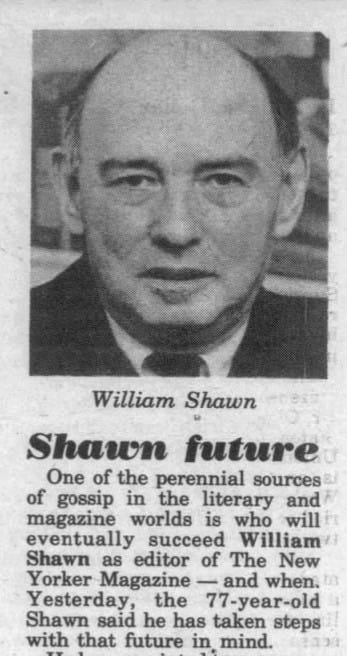
In 1974, at age 37, Robert Caro sold excerpts of his first book, The Power Broker, to The New Yorker magazine, one of the country’s most prestigious journals for literary writing, whose editor in chief, William Shawn, was only the second person to lead the enterprise in its forty-nine-year history, and had already become a legend in his own time. A mythic paternalistic figure to whom staffers pledged lifelong allegiance even though they couldn’t stand some of his editing practices, like the fact that you couldn’t call the thing people piss in a “urinal,” OK so you change it to “pissoir,” which of course only makes him impatient, because it sounds like you're trying to sneak some vulgarity into the magazine, and so the object ends up getting called “a circular curbside construction.”
But he published the likes of Truman Capote and J.D. Salinger. He brought John Updike into the fold. Serialized Hannah Arendt’s Eichmann in Jerusalem across five issues. Filled a whole one with John Hersey’s Hiroshima.
He was editor in chief for 35 years. He had eccentricities and gifts and charms and foibles that were unique to him.
Little by little, as time went by, the norms of the publishing world were displaced to accommodate his preferences, his innovations.
This happens at publishing houses too. When Robert Caro’s editor at Knopf, Robert Gottlieb, gave the job over to Sonny Mehta, after two decades on the job, they touched base to see how the transition was going. Mehta told Gottlieb, I spent months trying to figure out the system you used to run this place. Then I realized you were the system.
If it goes on long enough, it cultivates a distinct culture at the publication, or the imprint; if a whole culture is built around the leadership style of one person it means that, when that person goes, they take the era with them.
And Robert Caro, alone, has worked within the reality-distortion fields of all three.
If his books never quite made “corporate sense,” (i.e., designed to optimize profit) and would never now be repeated, we can look back through his career, the different reigns under which he published, and find the point where Robert Caro’s all-consuming project went from being a feature of its publishing landscape, to a relic.
It’s 1984 and The New Yorker’s editor in chief, William Shawn, is sharing an apartment with one of his staff writers, Lillian Ross, who’s also his mistress of nearly four decades, the two of them living in an apartment “about a half mile south of the one he lives in with his wife,” Cecille.
The details here come from Lillian Ross’s 1998 memoir, Here But Not Here: A Love Story, which is beautifully written, effectively elegiac, absorbing. It’s also kinda shady. Fixed on settling scores. A scrupulous reader won’t get more than a few pages deep without their eyes getting squinty about things like her description of Shawn himself; withdrawn, shy, softspoken and monosyllabic in the many memoirs in which he’s remembered, the William Shawn of Ross’s memoir is almost incontinent with angst and confessions, telling her he feels like a “ghost,” that he feels, in his marriage, both “there and not there.” He describes his job, in the largest office of the most respected magazine in America, as “the ultimate cell.” He asks her, “who has blotted me out?” She describes him as a “tormented man…[with] the desires of a poet but the duties of a caretaker.” Says his editorial duties siphoned his “genius” into other people’s work—to their constant credit. Bill, she says, “poured his gifts into others” and “found ways of concealing himself in them.”
Their affair is weird, as she tells it, and so is the book. Ross was known, in editor Robert Gottlieb’s words, for a “golly-gee, naive-girl-reporter manner,” like when she tells us at the beginning that Bill Shawn “longed for the earthiest and wildest kinds of sexual adventure. He was, as I said, a romantic.”
She gives us scenes from when she was a young reporter at the magazine, and it goes like this:
One time Bill and Cecille invited me to come up to their apartment on East Ninety-sixth Street; they had heard it was my birthday, and they wanted to celebrate it with a birthday cake. Cecille made a big effort to make the occasion seem natural, but the atmosphere was one of tension and nervousness. It made me wonder what I was doing there.
A threesome? That’s what comes to mind. And she probably wants a reader to think it.
But note what an eye she has for nuance, for suggestion; if she was getting threesome vibes she would almost certainly have ladled it on a bit thicker. This is a journalist’s skill: take a few benign details, measure the dispensation, and let a narrative take shape between the lines.
Earlier she says that Bill came to her and said that Cecille had said that she and Lillian had “lookalike faces.” Lillian is then distressed to cross a mirror and see that it’s true.
I used to meet Cecille occasionally at parties, where she would do a mean Charleston. I found her to be sensitive and likeable and intelligent, with resolute views.
A little while later Ross tells us that “One night when we were working on editing…in his office, Bill suddenly blurted out awkwardly that he was in love with me.”
When the big thing happens, she tells it to us straight. Better yet, consider this:
One day I was in my office, reading my New York Daily News, when Bill appeared. We looked at each other. It was late morning. Neither of us spoke. We went outside, got into a taxi, and, still without a word, went directly to the Plaza Hotel, got a pretty room, went to bed and stayed there for the rest of the day and evening.
How is it possible that she can lock eyes with her boss and understand, intuitively, that he’s leading her downstairs, into a taxi, a few blocks over to the Plaza Hotel where he’ll reserve a pretty room and invite her up to its bed to pursue “the earthiest and wildest kinds of sexual adventure,” but she can’t understand the tension of being invited alone, as an attractive young woman, into her boss’s apartment for an evening birthday celebration between him and his wife?
Roger Angell, who would himself serve as The New Yorker fiction editor for nearly 50 years, regarded Shawn as a paternal figure, adored him, stood up for him when corporate powers tried to force him out and yet, in hindsight, would describe Shawn, in his final era, as “a Lear in his old age, wishing obsessively to hold the magazine in his hands forever.”
But he loses it. Media moguls Samuel Irving (“Si”) Newhouse, Jr. will buy the magazine in a sale that Lillian Ross will characterize as a knifing, a scheme conducted behind Shawn’s back, arguing that he couldn’t have known it was happening, she contends, because Shawn was completely estranged from the business side of the magazine. He was too busy slaving over his editorial tasks and, apart from that, he’d sold off his stake in the New Yorker years ago to avoid (she claims) any impressions of personal interest in what he did or did not publish.
She resents those who learned, in 1987, of Shawn’s abrupt replacement and did not quit their jobs in protest; “a token gesture of solidarity,” she calls it, “after so many decades of [Bill] giving so much to so many people”; yes she’s wounded, in other words, by the fact that more people did not destroy their career at the most prestigious magazine on Earth as a “token gesture of solidarity” to the octogenarian—now being “forced” into the retirement she claims he wanted all along—who’d hired them in the first place.
She’s wounded, too, by the corporate partners who sold their shares in what she presents as a hostile takeover of the company, namely by that rat, Peter Fleischmann. Bigshot son of New Yorker co-founder Raoul Fleischmann. His family owned 32% of the magazine but Peter and his wife Jeanne controlled only 25%. Those other two major investors (Philip Messinger had just under 20%, depending on your source; William Reik had about 5%) were whatever, capitalist nobodies. You couldn’t expect loyalty from them.
Fleischmann, on the other hand, had stakes here. The New Yorker only got off the ground because of his father’s $750,000 investment.
This magazine was his father’s legacy, just as it was Shawn’s.
That he should have allowed the sale to happen was a betrayal.
First point of rebuttal: the reason the sale of the New Yorker might have blindsided William Shawn is that he banished all business dealings to a different floor of the building. “So [resolutely] had that wall between church and state [been set] that Fleischmann was not allowed to step foot on the editorial floor, and the magazine designated its in-house lawyer…as the sole liaison between the editorial and business department of the magazine.”
It’s easy to be blindsided when you put on a blindfold.
Another reason it’s hard to believe Lillian’s contention that Bill knew nothing about the sale is that, as Thomas Maier depicts so well in his biography Newhouse (1994), all of the millionaires and billionaires who adhere to this narrative are, at the time, running in the same circles; vast corporate convulsions will stem, if you trace them back far enough, to three billionaires literally physically bumping into each other at a fundraiser.
That’s what happened with Si Newhouse. People know he had his eye on the New Yorker (though they aren’t exactly sure why) and so it’s fortuitous when, at a Sotheby’s art auction, he runs into Donald Marron, a high-finance guy at the investment/brokerage firm Paine Webber. Marron doesn’t own any shares of the magazine. He’s out here schmoozing. But he knows a guy who does own a block of the New Yorker: William Reik. Another investment manager at the firm. Reik had been buying stock in the magazine “for himself and his clients” for years. “Attracted to the debt-free and family-run aspects of the company,” Maier writes, “Reik was also [like Newhouse] enamored with the prestige associated with the magazine.”
Aren’t we all. Newhouse certainly is.
And that’s why he wants that stock. But he doesn’t make a fuss about William Reik, doesn’t ask for the guy’s number, try to lean on him. No need! He sits here, instead, getting friendly with Donald Marron as priceless art gets sold all around them.
Donald Marron is more valuable to him than William Reik.
Donald Marron is William Reik’s boss.
One thing Lillian Ross neglects to mention about Peter Fleischmann—the honest broker with a 32% stake in the magazine, family blood mixed into the ink on every page—is that he’s all fucked-up healthwise. Cancer of the larynx. He just had an invasive surgery on his throat. Grueling. Long recovery. Once he’s all healed up, quality of life having plummeted to a new low, he lays down on a table and says, Alright I’m ready, and they wheel him in for another.
The way he talks in 1984 is by lifting this buzzy little taser-like device to his neck. It shoots a current that jiggles his vocal cords and then, by moving his lips, he can speak with a halting, patchy, robotic voice. Apart from his lawyer Ted Clark he also brings his wife Jeanne into the more delicate business meetings so she can translate his gravelphonics. As Thomas Maier writes, based on interviews with the man himself in ‘92, the need for a voicebox put limitations on Peter’s negotiations. The ability to speak quickly, with a strong voice, and have every word understood by the people you’re dealing with—it’s taken for granted.
To be deprived of those faculties was especially limiting in conversation with someone like Si Newhouse.
Among New York City billionaires in the 1980s, Si Newhouse is probably the most discreet. And not only cuz he’s five-foot-two. Although that’s according to a previous biographer. Newhouse takes issue. Whenever he overhears someone mention “five-foot-two” he throws them a squinty look like pinstripe homicide and tells em no, he tells em listen up, he tells em: “five-foot-three.”
Newhouse is sorta like William Shawn, actually: awkward, short, self-conscious, not that great with emotions. He has a capacity for tremendously single-minded focus when he wants something, he’s got at least the strategic resolve of a natural leader, plus he’s low to the ground which is a proven advantage in most forms of combat. He is co-owner, along with his younger brother Donald, of a media company called Advance Publications and they’re making a fortune right now off the relatively new advent of cable television, one of the medium’s top ten operators by 1981.1
His father was a newspaper mogul. The newspapers he ran were small, very ‘umble, but they earned a great fortune. 1983 was not itself the best year ever for Newhouse, in terms of PR. The IRS opened up a $900 million lawsuit against the father’s estate: $610 million for back taxes, another $305 million for fraud. Court records reveal that the company was valued at $1.5 billion.
But frankly he’s got more important things on his plate: in 1980, a year after his father’s death, Si Newhouse bought Random House for $70 million.
Of all available publishing houses, he didn’t go for one of the money makers; Simon & Schuster, for instance, is characterized by one of his biographers as having the sort of in-house culture that would have been better-aligned with a profit-minded course of action. They were more business-friendly. Random House, on the other hand, had a reputation for serious literature; it had, under its umbrella, the crowning imprint for literary prestige: Knopf.
Simon & Schuster was The Joy of Sex, it was Woodward and Bernstein, it was scandal and energy and lights.
Random House was not. It was tradition, ambition, prestige; it was Knopf.
And Knopf, in essence, was Robert Caro.
Si’s acquisition of Random House wouldn’t have been so remarkable if it he wasn’t also doubling down on one of his “glossy” properties: Conde Nast, a more luxurious brand today than it was at the time, with titles like Vogue and Glamour and Mademoiselle and Home & Garden—“chickens,” is how he characterized the many women’s magazines he owned over a business lunch, “only [other] chickens can tell them apart.” He hired a caffeinated young Brit, Tina Brown, to resurrect a retired monthly called Vanity Fair, which originally ran from 1913 to 1936; that she took as much heat for being a foreigner as for being celebrity-focused as for being a woman (really mostly just being a woman) without Newhouse ever flinching in his support attests to a longterm strategy on the owner’s part.
Put the it all together: Random House, the revivifying of Conde Nast, and now he’s chasing The New Yorker — this guy isn’t buying companies to switch up their image; he’s buying up companies to consolidate his own.
Operating at roughly the same authority as William Shawn, except it’s on the business side of the magazine, is the “president” or “publisher,” a guy named George Green. He’s friendly. Leave him alone. To his own devices. He knows the business. He can make inroads with advertisers, goose a magazine’s sales, its distribution, its “centrality to the conversation.” He can get eyeballs and ad dollars if you give him the space to operate.
Everybody knows about the church v. state separation that Shawn enforces at the magazine. So whenever the New Yorker does something innovative or ballsy with respect to marketing, or advertising, it’s likely that industry folk will point to it and say, “Look what George did,” and, “I wonder if Shawn knows about this.”
William Shawn has it easier than George does. His performance isn’t so quantifiable. If the New Yorker runs a poem and someone says it sucks and then Shawn says, “It does not,” well that person might be given a moment’s pause, doubting their own refinement; or, if they aren’t, then onlookers might.
To be perceived, in that manner, as someone who’s cultured or refined is invaluable in that 1980s culture of New York’s high society; it lifts you from the numbers bracket, which fluctuates so violently, depending on the markets, other variables.
The one signifier of status that doesn’t fluctuate, however, is your class. Whether people think you’re interesting, cultured, refined.
Plus William Shawn likes the fact that 75% of New Yorker readers have some college under their belt, and 25% have some post-graduate education too. These were the elite. His job was to make a magazine those people wanted to read—and he was doing it.
If he had his druthers, they’d be the only ones who did read the magazine.
George Green, on the other hand, had to show results.
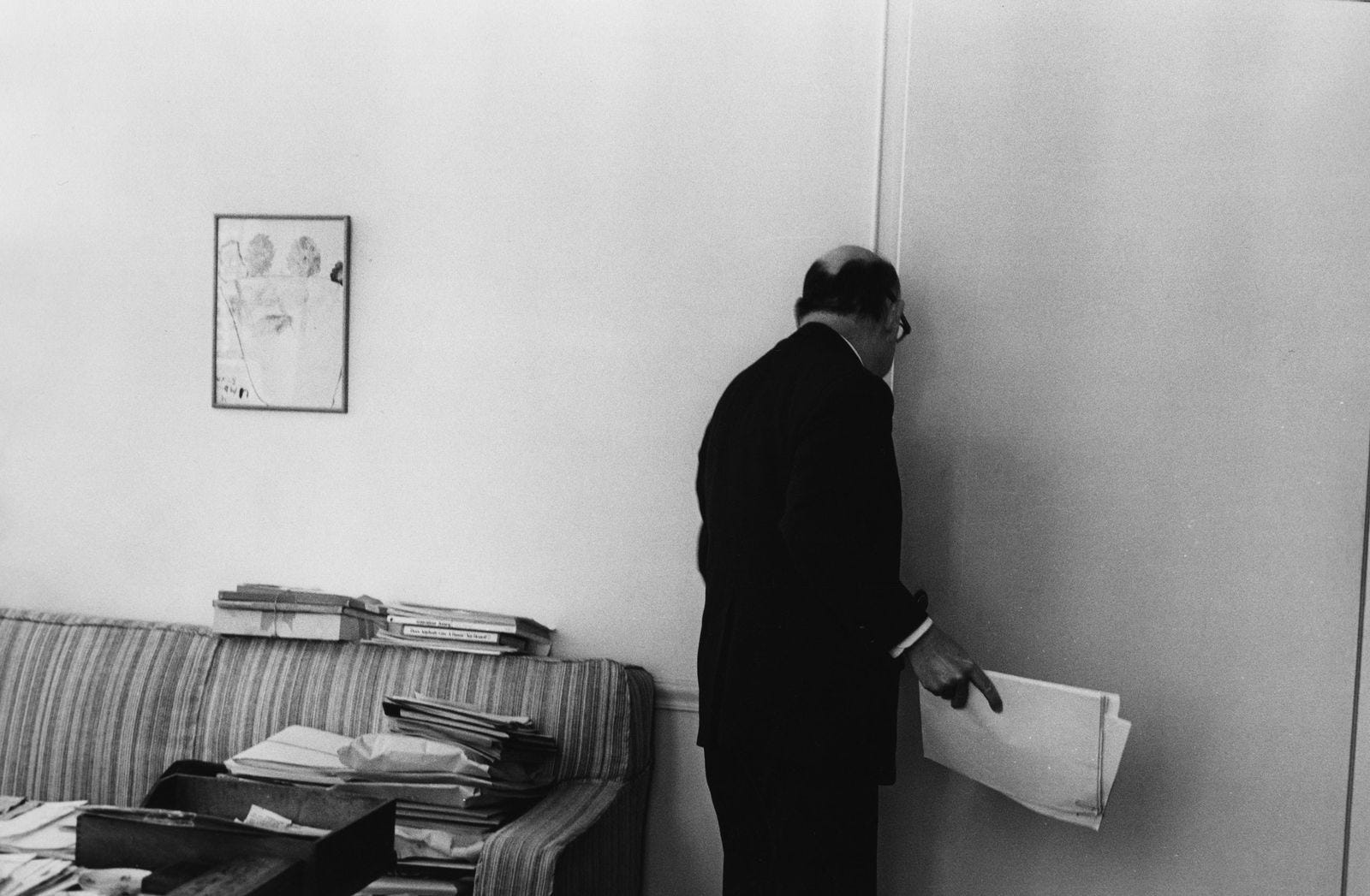

What Shawn refuses to acknowledge, c. 1984, is that even those elite readers, the sophisticates to whom he imagined himself catering, are getting wary of his approach. The most-cited instance of his slipping curatorial judgement is greenlighting multi-part articles about corn.
As Tina Brown put it, when her own name got dragged into the decade’s magazine wars for being too young or unserious or girly:
Once in a while…I run into a flabby old cliche about what constitutes a “serious” magazine. It’s the mealymouthed idea that visual excitement is somehow at odds with intellectual content, that [a magazine] can be deemed worthwhile only if it is presented as a wad of impenetrable text with a staple through the side.
You didn’t need the title to know which magazine she was talking about.
So here’s George Green, he’s doing his job, he’s “aggressively courting” advertisers, he’s pitching ideas to Shawn about what they can do to make the magazine more popular, more profitable—and Shawn keeps shooting him down.
One of those ideas was to invest in a new English-language version of the French fashion magazine Elle.
Shawn said a fashion magazine was beneath them.
Of course, Elle comes out and it’s an explosively popular hit, bright and tall and colorful with lots of smiles inside. Who’da thought! Green just has to chew his knuckle about it, like everything else.
Eventually Green snaps after Shawn denied an “advertorial” (where a full-page ad, dense with copy, is disguised as an article) because he thought it was “beneath” the magazine’s “dignity.” When Peter Fleischmann then agreed with him (reluctantly, it seems), Green said fuck this, and quit, They don’t want to make money? Fine.
So he did a quick jump over to Hearst Communications. Started publishing two magazines.
Turns out those Hearst people love money.
Well, some of the leadership would like to see growth, and Green’s departure is an eye-opener on that front. Specifically for Philip Messinger. Sitting on major stake in a company run by what seems like an increasingly hermetic, erratic, Lear-like editor in chief—but it’s hard to prosecute a case against Shawn on that front because you couldn’t always tell which qualities were fiscally ruinous and which qualities were, like, the eccentric byproduct of genius.
What’s clear is that Shawn is buying into his own mythos, as he’d been doing to some extent over the past twenty years or so, going back at least to 1965 when Tom Wolfe wrote a takedown of the magazine called “Tiny Mummies,” which of course has a fourteen-word subtitle, leaden and stony and chucked directly from the porch of Wolfe’s own glass house, describing Bill Shawn as “the museum curator, the mummifier, the preserver-in-amber, the smiling embalmer,” plus a few other things.
Shawn read an early copy and lost his mind. Called Wolfe’s editor and said the article had to be withdrawn, for the good of everyone involved, called it “a vicious, murderous attack on me and the magazine I work for.”
But really what had put Messinger on alert was this: he was at a party that year and ran into a New Yorker staffer, Nat Hentoff, who vented about a popular lament at the office: writers were spending months (in some cases years) reporting a story, revising it, getting editorial input, bringing it up to standard. Then Shawn would read it. He’d be pleased. He’d buy the thing. Thousands of dollars, usually—and then he’d never print it.
And now, with the Elle thing, it wasn’t just Shawn’s judgement he had to worry about, but Fleischmann’s too.
Messinger’s thinking about jumping ship from The New Yorker.
So Si Newhouse pays him a visit.
There are several books on several subjects that all tell this next part of the story with different points of emphasis, different readings and details, so this is the best reconstruction I can figure:
It’s 1984. Newhouse isn’t likely to succeed in buying the magazine if he goes directly to the major shareholders and makes them an offer. In fact that would only make them suspicious. Like maybe he knows something they don’t know. Or maybe it just signals how badly he wants it.
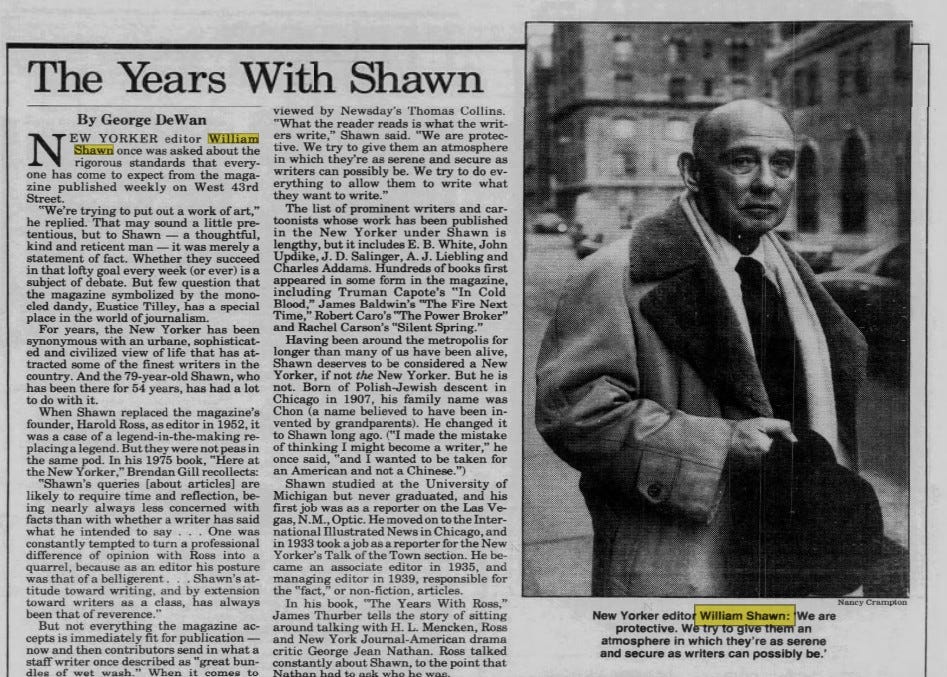
So his strategy appears to be this: show the major shareholders (Fleischmann, Messinger, and Reik) that you’ve gone ahead and done some legwork and acquired a sizeable portion of the company on your own. Then show up, present them with your own holdings, and tell them they’re either gonna have to contend with you as a major force on the board, implementing such changes, challenging norms, creating such a ruckus that this not-so-lucrative holding in their portfolio is suddenly demanding huge amounts of their time and attention, tell them they can either do that…or they can let you just take the burden off their hands altogether. Buy them out right now. At a 50% premium. Paid over the course of a year.
So Newhouse does some research. He learns that, back in the 1920s and ‘30s, the New Yorker sometimes paid its writers with stock shares.
Some of those writers sold it off, or they died and passed it on to their kids, and then the kids either sold it or kept it languishing in some corner of their portfolio.
Newhouse tracks it all down.
He buys a few shares here and a few shares there, generational degrees of separation from the writer to whom they were first paid out. A hundred shares from James Thurber’s godson’s mistress’s cat. He piles block upon block and yes these are private transactions, very lock-and-key hush-hush, but the fact nobody likes to acknowledge is this: stock brokers, at around 5 p.m., get up from their desks and push their office windows open and scrabble down the sides of their buildings, suitcoats bundling down like capes over their heads, backbending down onto 5th Avenue or wherever and then hey, guess what, they go and they have drinks with their friends just like the rest of us. And after a chalice or two the shoptalk turns to gossip.
Word gets around: Si Newhouse is orchestrating a takeover.
All through the summer, said Fleischmann, “the stock was jiggling around and I knew that something was going on. I thought it might be Newhouse but there was no way I could trace anything.”
Si Newhouse buys out Philip Messinger.
Si Newhouse buys roughly 2% from William Reik, over at Paine Webber.
Word keeps spreading.
The stock keeps jiggling.
Ken Bosee, the magazine’s treasurer, had just recently estimated the stock’s value at roughly $90/share, according to Carol Felsenthal, and now, as the summer of ‘84 gives way to the fall, it’s ticking past $120.
By November 14, the New Yorker is trading at $140.
“Newhouse to Acquire 17% of The New Yorker,” the Times reports.
He calls Peter Fleischmann: “I would like to make an offer to buy some stock in the magazine.”
Fleischmann with his voicebox croaks back sotto roboto: “I’d rather you didn’t.”
As Jeanne Fleischmann would recall, after sitting in on all those meetings: “Peter was a gentleman. When he said, ‘I’d rather you didn’t’...that meant, ‘Please don’t.’”
Newhouse tells him, “It’s only for investment purchases.” Advance Publications puts out a press release saying they’ve got “no plans to seek control of The New Yorker or to influence its management.”
Yeah yeah, tell that to Fleischmann, he’s home in his wood-paneled office, watching the stock of a weekly culture magazine nearly double for no discernible reason except there’s a very small man in his apartment, staring at him, talking in circles, something about “chickens.”
“[Newhouse] offered to buy just a block, but I knew he wanted the whole goddamn thing.”
So does everyone. What’s more important is the other thing he knows.
“I knew he would never stop until he had the whole thing.”
But the real question for Peter Fleischmann isn’t strategic, it’s not when or how or where the final Newhouse thrust will come; the question is this: why fight it?
He’s 63. Guys his age are already thinking about retirement. He’s got money. Family. If things were different he’d probably go on like his father, working into his eighties, til he absolutely physically couldn’t do it, so ardently did he care about the magazine.
But look at him. The cancer, the surgeries. The voicebox. It feels undignified, kowtowing to a takeover, especially to someone you’ve politely rebuffed. Like a gentleman. Someone who’s dismissed your preference and gone around your back to take the thing he knows you care so much about.
It kills him. His pride.
On the other hand: he opens his mouth, tells his wife he loves her, it sounds like a Speak & Spell. How can he not be thinking about mortality, the legacy of the magazine? If something were to happen, and a doctor tells him tomorrow that he’s got six weeks to live…does he really want to spend that time in meetings, scavenging for the right owners, who in any case are gonna take advantage of his eagerness, his illness, buy it for some low-low price probably just to wait til he’s dead and then flip it for a profit, or turn it into something unrecognizable?
The answer’s no. He doesn’t want that.
On the other hand: Newhouse, he realizes, “was worth $5 billion, $10 billion? There was no way I could fight that money.”
So another question: Is Si Newhouse the best person to entrust with The New Yorker so that it’ll go on embodying the values that William Shawn and the Fleischmanns have imbued it with for decades?
Well. Here’s an easier question: What’s the alternative?
“The only thing you can do in that situation is try to get as much money as you can for the sale.”
Carol Felsenthal’s biography, Citizen Newhouse, says it was in their third meeting at Peter Fleischmann’s home office that Si dropped his “investments only” shtick and came clean: he wanted it all. In February 1985 he went to the New Yorker’s board of directors and offered to buy the magazine at $180/share.
The board said no, but Si had the opportunity to go around them and make an offer to the shareholders themselves. It seems the board advised Fleischmann to hold out. This guy wants it bad, and he knows he’s close.
Sure enough, a couple weeks go by, Newhouse circles back: he’ll pay $200/share.
Peter Fleischmann doesn’t want to do it but, again, what’s the alternative? Plus he’s likely got Ken Bosee’s estimate in his head: these shares are worth NINETY DOLLARS.
But Fleischmann has one more tactic to deploy. One more shot at scaring Si Newhouse away from the magazine on the brink of a landmark deal.
He knew only one person who could do it.
Testimonies overlap, they negate the smaller details, but the gist is this: either Warren Buffett or his business partner Charlie Munger took an opportunity, in 1971, to buy up 16% of The New Yorker. Then they were interested in buying the whole thing. About eight years prior Katharine Graham’s husband Phil Graham had started to waver in his position as publisher of The Washington Post. He was bipolar, an alcoholic. He was institutionalized. He got better. They gave him clearance to go home and visit with her for a weekend. They ate lunch. She took a nap. He went to the bathroom downstairs and put a shotgun to his head and woke her with a bang. Katharine Graham stepped into his role as publisher and performed like she was born to it. Became one of the most powerful figures in American media. Tall and kind and elegant but her vibe was the color of fighting and it was Buffett who approached her and said, Let’s form a partnership and buy The New Yorker.
Graham was interested, but it seems only mildly; Buffett went to Peter Fleischmann on behalf of the partnership and did his normal acquisition pitch.
Fleischmann said, It comes with William Shawn.
Buffett said, Great.
Fleischmann said, Yes. Go have lunch with him.
So Warren Buffett goes to lunch with William Shawn. He gave his pitch: I buy a company because I like how it’s operating. I’m not looking to get in there and shake it up. But I would like a more comprehensive idea of how it operates.
Shawn, probably panicked at the prospect of change, starts shifting over his cornflakes. He explains to Buffett how the magazine works. How utterly impossible it is. A precarious balance of extremely volatile elements. Cartoonists and writers. Warren, listen to me: they weep. Memoirs will confirm the bottles of wine and rum they keep in their offices. Others will talk of their emotional collapse under the weight of a story and how they showed up at midnight or 2 a.m. to Bill Shawn’s apartment where he greeted them in a bathrobe while they wept and then, when they apologized, he’d assure them that they were not the first.
Fleischmann later told the New York Times: “They talked for an hour and a half and when [Buffett] came back he said, ‘I’m not terribly interested in buying the magazine.’”
Selling The New Yorker at $200/share, Peter Fleischmann stood to earn $40 million.
And he was resigned: if the sale has to happen, then these are the best possible terms.
Still, he deployed his one remaining deterrent.
He said to Newhouse, Before I can agree, I need you to know what you’re getting into.
Newhouse was 63 inches of attention.
He said to Newhouse, I want you to meet with William Shawn before we sign.
Worried someone from the press would see them together, and jump to conclusions, William Shawn and Si Newhouse met at the apartment of Ted Clark (Fleischmann’s lawyer). Two short men, uncomfortable about such meetings, forced into just such a meeting, a sense of the Rubicon burbling underfoot.
Newhouse invites Shawn to explain the operation, just as Buffett had.
Shawn proceeds to speak from the heart about what the New Yorker means, what it represents, how it operates. That the reason it is such a wonderful magazine is because it has no profit motive. It can’t. They burn through money without a moment’s pause. “We would send a fact checker by the Concorde to London to check on a fact,” he says. “We would make a long-distance telephone call to an author in Los Angeles to ask his permission to change a comma…We publish things that we think should be published, not because we think our readers will like them or even that many will read them, but that they are important. And no businessman would put up with that.”
As Felsenthal explains in her biography: Shawn clearly did not understand who he was meeting with. Newhouse was a businessman, yes, but his purchase of the New Yorker wasn’t about profit. Nobody seems to’ve known what it was about.
Clark, keeping to himself but consecrating every detail to memory, felt the sale solidifying right in front of him. “Every time Shawn said something like, ‘Send the Concorde to England to check a fact,’ you could see Newhouse [thinking], ‘This is even better than I thought.’”
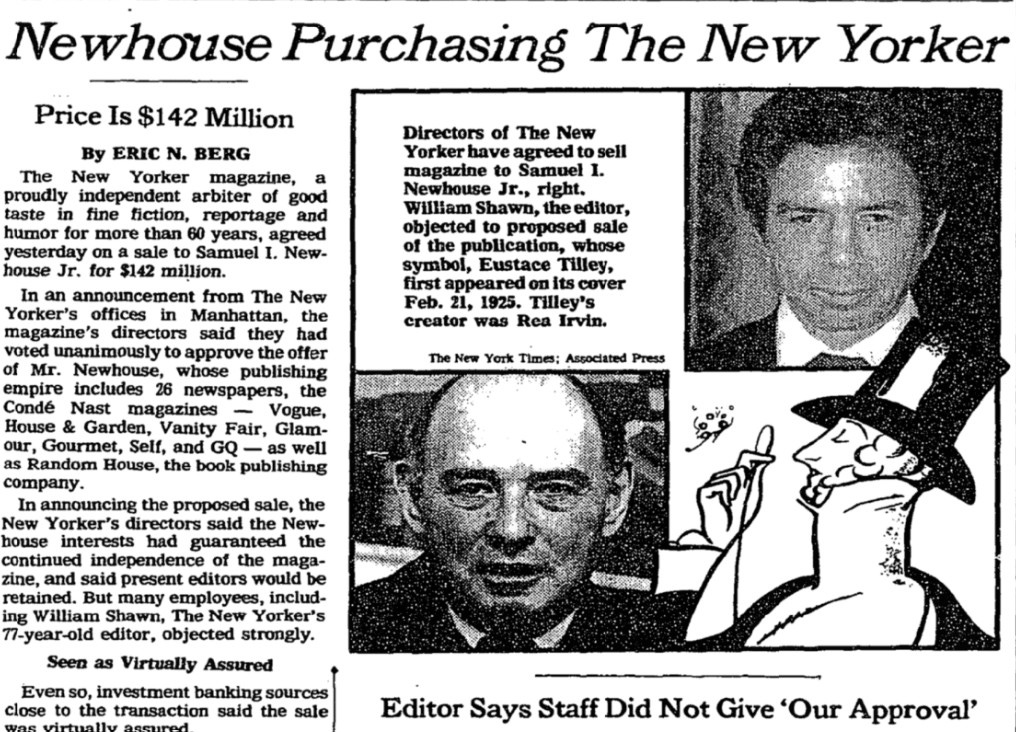
When the sale was announced, in March 1985, the magazine’s staff would convulse with shock, outrage, grief.
They looked to William Shawn, who said little.
But standing behind him was Lillian Ross.
She told them, Let’s stop this from happening.
PS
A Note on Sources
This installment in the ongoing Robert Caro series is informed, primarily, by the following eight books. Each of them tells the same story from a slightly different perspective.
Year of Change by E.J. Kahn, Jr. (1988)
Newhouse by Thomas Maier (1994)
Here But Not Here by Lillian Ross (1998)
Citizen Newhouse by Carol Felsenthal (1998)
About Town by Ben Yagoda (2000)
The Snowball by Alice Schroeder (2008)
Avid Reader by Robert Gottlieb (2016)
Empire of the Elite by Michael Grynbaum (2025)
The New York Times reported that H.B.O. (it still wore the dots) charged its eight million subscribers an average of $8 a month, generating $400 million a year (about $1.5 billion in 2026).
This was wonderful to read.
I worked at the New Yorker from 1986 to 1988, during which time Mr. Shawn stepped down. I was at first the secretary to the liquor ad salesman and then in promotions where I fact checked the first “advertorial.” Those were strange days, especially after Reagan’s tax bill killed the three martini lunch. Excellent piece.