How the Sharpie Saved My Novel
Tips and for getting out of the editing weeds.

1.
I’ve spent almost five years researching and writing a novel about the sociopolitical infrastructure that gave birth to Prohibition and also a gigantic monster from Cuba and this naturally required lots of research: more than 30 books in the first two years. I called a library in Chicago and chatted with an expert. I read through some court filings and scores of old magazines. There was one month in 2023 where JSTOR told me, “No that’s it. That’s all you get.”
Meanwhile the novel-in-progress became stupidly long because I would learn something interesting and get sidetracked. I wrote a 30-page digression about how William Randolph Hearst and Teddy Roosevelt went to Harvard together and absolutely loathed one another and then for the next 40 years took pot shots at each other in the press until Teddy sent Hearst a message when they were old men saying, “You’re a good guy,” and Heart could not deny anyone wise enough to recognize this and became, thereafter, a fan.
Point being: I started to feel defeated by this project. Like it might not come together and the problems were marrow-deep and I should just cut my losses.
But starting in January I took one more reluctant shot. I employed two tactics to guarantee ruthless progress and they have saved the book entirely.
It’s the best thing I’ve ever written.
I think I’ll be done with it in a few weeks but for now I’ll just tell you how I saved it.
2.
Coming up on the fourth year I lost hope and set the book aside for months because I was lost in the weeds.
I knew the biggest problem was its ridiculous four-digit pagecount and that the only way it would ever be a viable book is if it lost half its length.
I knew that James Ellroy reduced LA Confidential from an unpublishable 1,200 pages to 500 by (mostly) shortening all sentences. Two words instead of ten. Staccato. Like telegrams. They’d complement his themes. It’s still a good strategy. But it wouldn’t fix everything.
My day job (retail) provides us with a box cutter and nametag and also a big fat Sharpie that I use a dozen times a day and now it’s just constantly in my pocket and I like it.
All those things came together and I went to the library after New Year’s Eve.
“One more shot.”
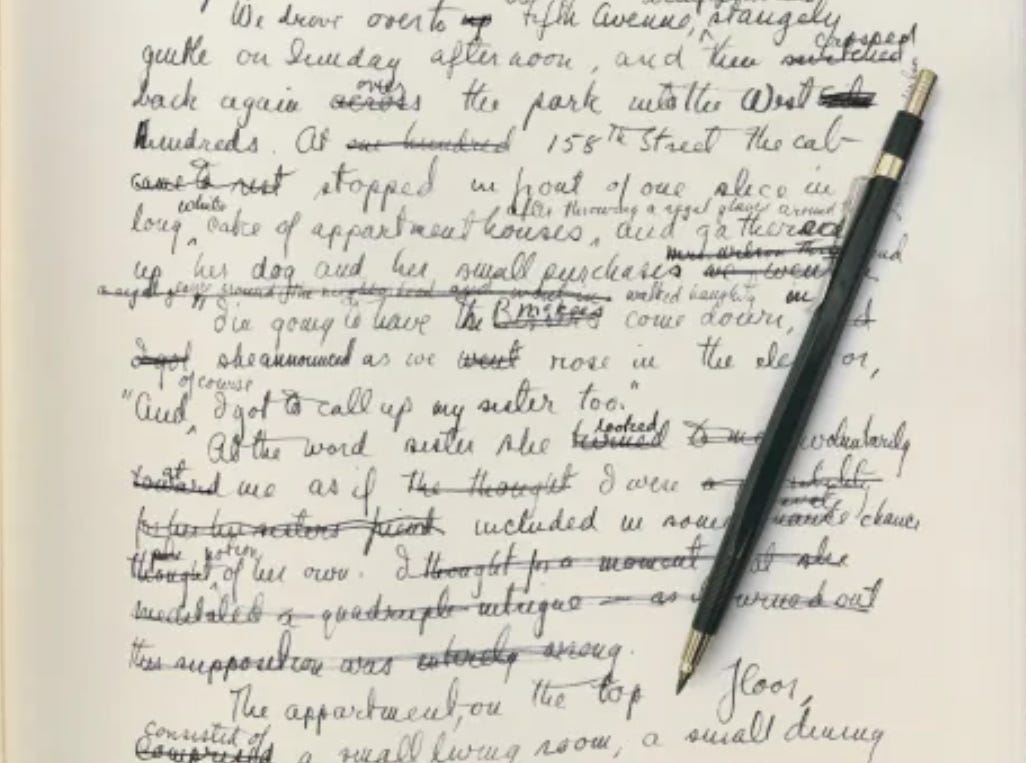
Printed out just the first 100 pages of the book and instead of going through it with a pen, as I normally do and which turns me into a stodgy perfectionist, I just held one of the fat black Sharpies and set a rule: for the first 25 pages of this edit I could not re-write anything—I could only drag the Sharpie across words, redaction-style. Instead of that haunted eternal question, How Do I Fix This, the only thing I was allowed to ask myself was, Why Is This Here?
It worked.
I only did it for about 12 pages because suddenly I knew how to fix every major problem in the narrative.
3.
Here’s a new rule I’ve applied for any draft beyond the third: if in the course of revisions I find myself laboring over a sentence for more than one minute, then I clearly don’t know what it’s doing, and it needs to be removed.
But here’s a tricky caveat: sometimes I will tell myself that the reason a particular sentence (or scene) is so delicate, and needs lots of fussing, is because it’s doing three or four discreet things at once. I can explain the things they’re doing, but I cannot name them.
This is me bullshitting myself. Inventing reasons to hold onto something even though they’re all abstract and subordinate to the reason I’ve decided is the most important: tell a good unpredictable story that moves fast fast fast.
As you proceed from one draft to the next, and the story becomes more layered/complex, your motives—at inverse proportion—must become simpler/clearer.
When defending the existence of a passage in your novel, five explanations comprise a lesser engine than one singular purpose.
4.
Using only the Sharpie in the first ten pages I realized that the solution for almost all of my narrative problems was to remove things I’d fallen in love with. Specifically a storyline built on roughly 3,000 pages of research and a full year of writing. (Teddy Roosevelt traipsing through Spanish-occupied Cuba, insulting everyone’s lisp.)
It’s disappointing to slash through whole pages but I’ve reduced the first 150 pages to 100 and I’m seeing the narrative dots pull together like a magnet dragged over filament and it’s one of the most best writing experiences I’ve ever had.
5.
If someone asked Elmore Leonard why there was so much violence in his books he would argue back that there was not so much violence in his books.
The books, he said, have guns. And people getting shot. But the shooting isn’t gory and the gun—he’s adamant about this—is not a gun; it’s a device that reveals a character’s priorities. The thing they’d kill (or die) to achieve (or avoid).
He didn’t just know why it was there. He knew exactly what it was in the text, and the subtext. He cared most about character and voice and motive. He wrote into those values. It opens him up to criticism—but criticism feels a bit empty, cuz he’s showing you what he cares about most, and those are the places where he’s doing the best work.
So, to stretch a metaphor here, I’d say the key is to figure out what your gun is and learn when and why to deploy it.
Mine, I think, is a Sharpie.
Thanks for reading! Paid subscribers will get another post tomorrow with the weekly voicenote.
BTW The library in small town New Zealand has a copy of CUBAFRUIT! I asked, it appeared.
YEP. Yep. Learning to love the knife (aka the sharpie) is the best thing possible.
Much less extreme, but I had to reduce my first novel from ~140,000 words to 100,000. This was literally a condition of my contract. And it was awesome. Now I get a thrill out of cutting words. It’s kind of sick